

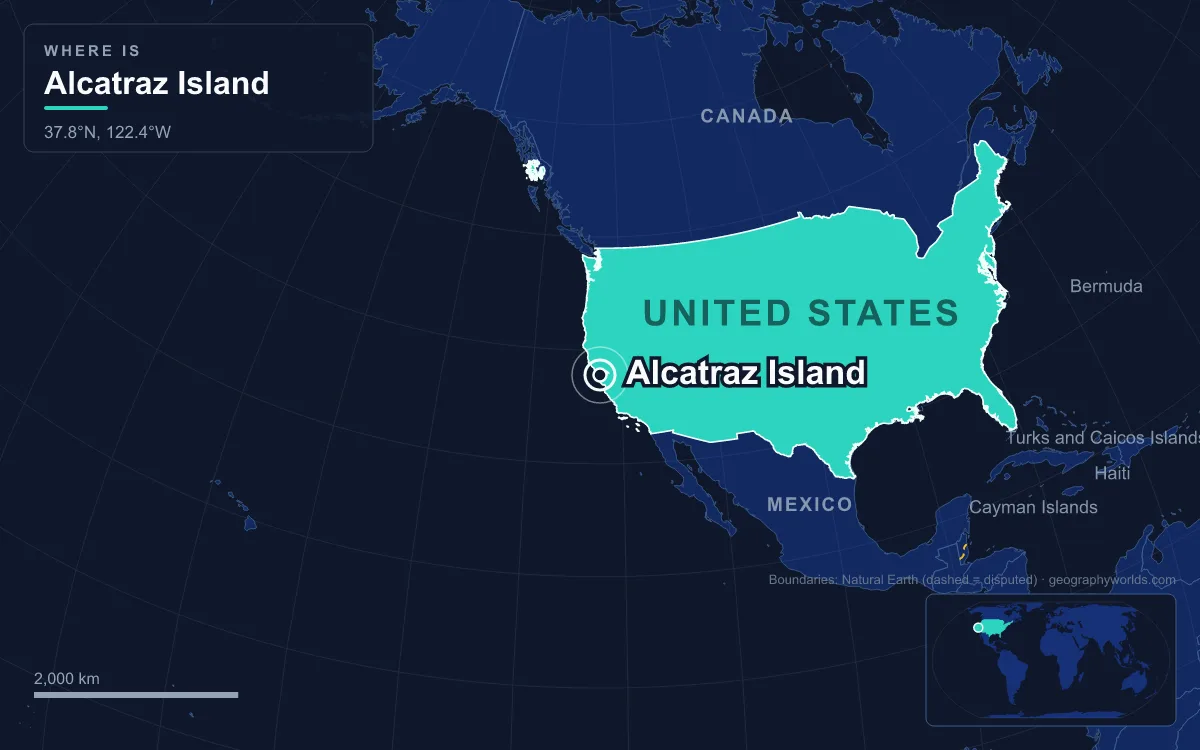
Alcatraz Island is a small, steep-sided rock in the middle of San Francisco Bay, California, about 1.25 miles (2.01 km) off the San Francisco waterfront and just inside the Golden Gate strait. It covers about 22 acres (8.9 hectares), measures roughly 1,675 by 590 feet (511 by 180 m) and rises to about 135 feet (41 m) at mean tide. In under two centuries it has been a seabird rock, a Mexican land grant, a US Army fort with the first lighthouse on the West Coast, a military prison, the federal penitentiary known as "The Rock" (1934–1963) and the site of a 19-month Native American occupation. Since 1972 it has been part of the Golden Gate National Recreation Area, run by the National Park Service and visited by roughly 1.4 to 1.7 million people a year depending on the source and year.
1775–1846: Ayala’s Isla de los Alcatraces and a Mexican land grant
Long before Europeans arrived, Indigenous people of the Bay Area knew the rock; the island’s lighthouse history records that they visited to collect the eggs of the birds that crowded its ledges. The first Europeans known to have entered the bay were the crew of the Spanish packet ship San Carlos under the naval officer Juan Manuel de Ayala, who passed cautiously through the Golden Gate against the tides on 5 August 1775. Ayala found his best anchorage off Angel Island, stayed until 18 September, and sent the Viceroy a full report on the bay’s geography along with a chart.
The name, though, was first attached to a different island. On 12 August 1775 Ayala labelled today’s Yerba Buena Island "Isla de los Alcatraces", from the archaic Spanish alcatraz. The word is often translated as "pelican", although it can also mean "gannet"; since no gannets are native to the Pacific coast, the pelican reading is considered more likely. The name was later moved to the bare rock nearer the Golden Gate by the English naval officer Frederick William Beechey, who surveyed the bay during his 1825–1828 voyage in HMS Blossom. In 1827 the French captain Auguste Bernard Duhaut-Cilly found it covered with countless birds.
Under Mexican rule the island acquired its first recorded private owner. In June 1846 Governor Pío Pico granted it to Julian Workman, the baptismal name of William Workman of Rancho La Puente, on condition that he build a lighthouse. Later that year John C. Frémont, acting as military governor of California, bought it for $5,000 in the name of the United States from Francis Temple. Washington later invalidated the sale, and Frémont’s heirs sued without success into the 1890s.
1850–1859: Fort Alcatraz and the West Coast’s first lighthouse
The Treaty of Guadalupe Hidalgo of 1848 handed California to the United States, and the gold rush that began the following year filled San Francisco Bay with ships. In 1850 President Millard Fillmore set the island aside as a military reservation. The bay now needed both defences and navigation lights, and Alcatraz could supply both; the geography of the California Gold Rush explains why so much shipping was suddenly converging on the Golden Gate.
Congress passed acts in 1851 and 1852 for seven West Coast lighthouses, and the Baltimore firm of Gibbons and Kelly won the contract. The Alcatraz tower was completed first, in July 1853, and was lit on 1 June 1854 with a fixed third-order Fresnel lens, making it the first lighthouse built on the US West Coast. Damaged in the 1906 earthquake and soon blocked by the new cellhouse, it was replaced in 1909 by today’s 84-foot (25.6 m) concrete tower, automated in 1963.

Fortification began in 1853 under Zealous B. Tower of the US Army Corps of Engineers and ran until 1858, when the first version of Fort Alcatraz was finished. A garrison of about 200 soldiers arrived at the end of that year. The fort was meant to form a "triangle of defense" with Fort Point on the southern shore of the Golden Gate and Lime Point on the northern shore, though the Lime Point works were never built.
1861–1933: Civil War guns and the Pacific Branch Disciplinary Barracks
When the Civil War broke out in 1861, Alcatraz mounted 85 cannons in casemates around its edge, rising to 105 by 1866, and doubled as the San Francisco Arsenal so that firearms would not fall into Confederate sympathisers’ hands. Its guns were never fired at an enemy. The island became the military prison for the Department of the Pacific in 1861, holding prisoners of war, Confederate privateers and, after habeas corpus was suspended in 1863, civilians accused of treason.
Rapid advances in artillery left the fort obsolete within a decade. Between 1870 and 1876 the army began a plan to level the entire island and dig shell-proof magazines beneath it; the work was abandoned, and the flat parade ground at the southern end is all that was achieved. Detention took over instead. A brick jailhouse went up in 1867, and in 1868 Alcatraz was designated a long-term military prison. The Spanish–American War of 1898 pushed the prison population from 26 to more than 450.
On 21 March 1907 the island was formally named the Western US Military Prison, renamed the Pacific Branch, US Disciplinary Barracks, in 1915. The building that still dominates the skyline dates from this era. The main cellhouse, designed by Major Reuben Turner, was built between 1909 and 1912 for about $250,000 on top of the old Citadel barracks, whose lower floor became its basement and gave rise to the legend of "dungeons" underneath. At about 500 feet (150 m) long it was reputedly the longest concrete building in the world when completed. The army deactivated the barracks in October 1933.
1934–1963: The Rock under Warden James A. Johnston and his successors
The Department of Justice took over on 12 October 1933, and after about $260,000 of modernisation Alcatraz opened as a federal penitentiary in August 1934. At 9:40 am on 11 August, the first 137 prisoners arrived, brought by rail from Leavenworth, Kansas, to Santa Venetia, California. The first warden was James A. Johnston. Al Capone arrived that August and stayed until 6 January 1939; George "Machine Gun" Kelly, Alvin Karpis and Robert Stroud, the "Birdman of Alcatraz" (who was not allowed to keep birds there), were among the other inmates.
The prison was small by design. Cells measured about 9 by 5 feet (2.7 by 1.5 m), none of them touching an outside wall. A 1960 Bureau of Prisons booklet gave an average population of 263 between 1935 and 1960, peaking at 302 in 1937. An inmate register lists 1,576 prisoners in all, though some counts give 1,557.
The island’s geography was the main security system: 1.25 miles of cold, fast water separated the cellhouse from the city. Over 29 years, 36 men made 14 escape attempts. The bloodiest, the Battle of Alcatraz of 2–4 May 1946, left two officers and three inmates dead. On 11 June 1962 Frank Morris and brothers John and Clarence Anglin left papier-mâché heads in their beds, climbed through the ventilation ducts and launched a raft made from prison raincoats. They were never seen again, and in 1979 the FBI concluded they probably drowned.
Isolation also made the prison expensive. A 1959 report found it cost about $10 per prisoner per day, against about $3 at Atlanta, and the island had no fresh water, so nearly a million gallons a week had to be shipped from the mainland. Salt spray had eaten into the concrete, with repairs estimated at $5 million. Attorney General Robert F. Kennedy backed a replacement at Marion, Illinois, and Alcatraz closed on 21 March 1963.
1969–1971: Indians of All Tribes and the 19-month occupation
The closure gave Native American activists an opening. Belva Cottier and her cousin Richard McKenzie argued that if the island was surplus federal land, the Sioux could claim it under the Treaty of Fort Laramie of 1868. On 8 March 1964 a small group of Lakota acted on that argument and occupied the island for four hours.
The far larger occupation began on 20 November 1969, after the San Francisco Indian Center burned down that October. A group calling itself Indians of All Tribes, led by Richard Oakes and LaNada Means with John Trudell as spokesman, landed on the island and stayed for nineteen months, demanding an Indian education and cultural centre. Fires during the occupation destroyed the Warden’s House, the lighthouse keeper’s home, the Officers’ Club and other buildings; their cause is still disputed. During the occupation President Richard Nixon ended the federal policy of Indian termination in favour of self-determination, partly in response to the publicity it generated. Federal officers removed the last occupiers on 11 June 1971.

1972 to today: Golden Gate National Recreation Area
In 1972 Congress created the Golden Gate National Recreation Area, and Alcatraz passed to the National Park Service. The whole island went onto the National Register of Historic Places in 1976 and was designated a National Historic Landmark in 1986. Ferries run from Pier 33, between the Ferry Building and Fisherman’s Wharf, under a contract held by Hornblower’s Alcatraz City Cruises. From the western side the view runs straight out through the strait to the Golden Gate Bridge.
The island has also become a nature reserve in miniature. The western cliffs, close to 100 feet (30 m) high, hold nesting western gulls, cormorants, pigeon guillemots and Heermann’s gulls, and harbour seals sometimes haul out on the beach below. Black-crowned night herons breed in the rubble of the parade ground and along the Agave Path on the south shore. Tide pools left by old quarrying are among the few in the bay. Gardens planted by army and prison families, neglected after 1963, have been restored with help from the Garden Conservancy, turning up survivors such as the Bardou Job rose, once thought extinct.
The penitentiary has never quite left politics. In 2008 San Francisco voters rejected Proposition C, a plan to replace the prison with a peace centre, with 72 per cent voting against. In May 2025 President Donald Trump proposed reopening it as a prison, and the White House’s 2026 budget request included $152 million for that purpose.
For the water that has shaped every chapter of the island’s story, from its tides and shipping lanes to its other islands such as Angel and Yerba Buena, read our guide to San Francisco Bay, or compare Alcatraz with another island prison turned memorial in our piece on Robben Island in South Africa.