
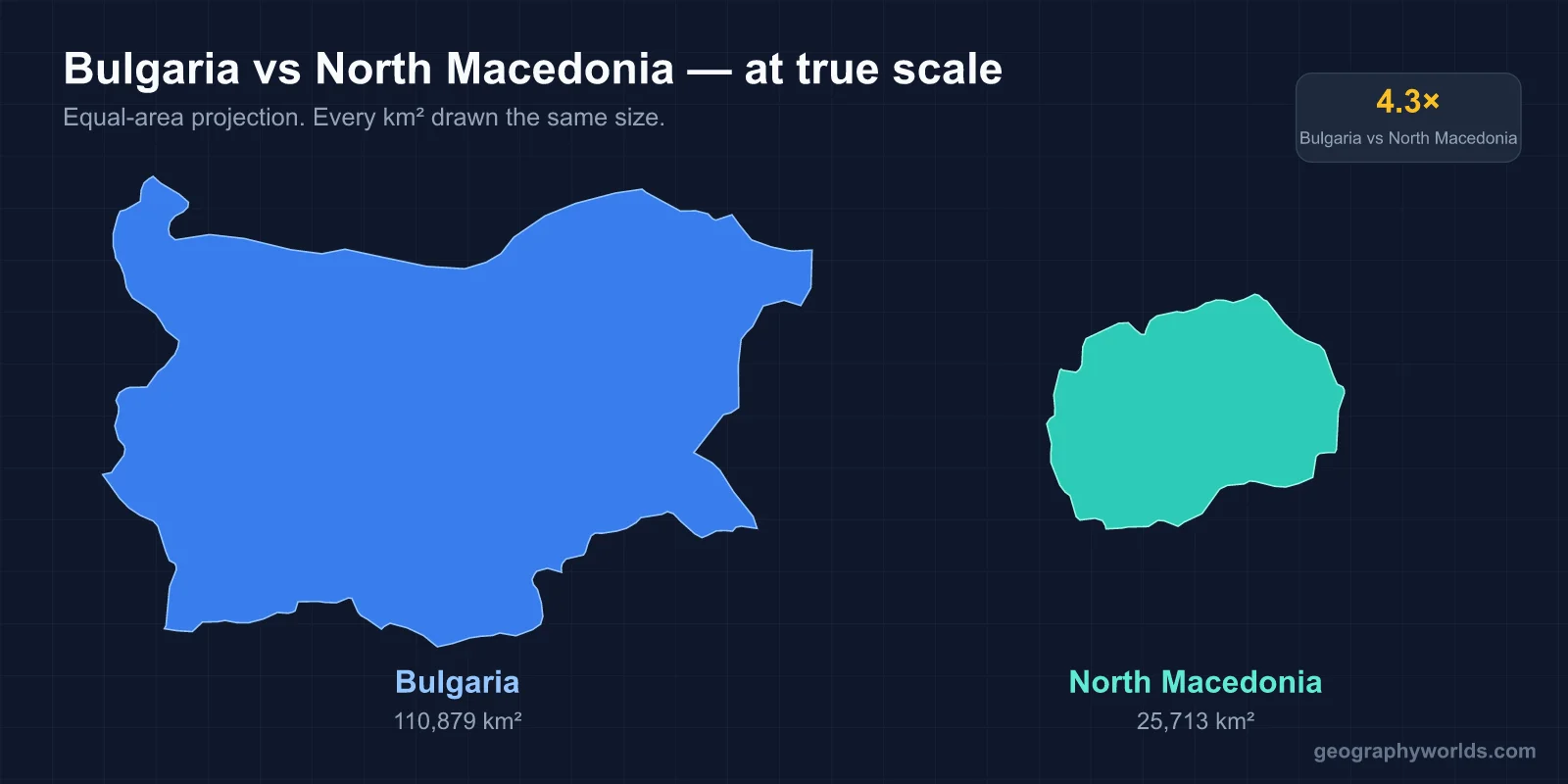
Bulgaria is about 4.3 times larger than North Macedonia (roughly 111,000 km² against 25,713 km²) and has about 3.5 times as many people (6.42 million at the end of 2025 against 1.84 million at the 2021 census). The two neighbours share a Slavic language family, an Orthodox church tradition and five centuries of Ottoman rule, but Bulgaria is now in the EU, Schengen and the eurozone while North Macedonia's EU accession talks are stalled by a Bulgarian condition about history and identity.
The Veto: Why Sofia Holds the Key to Skopje's EU Talks
The difference between these two countries that matters most today is political. On 17 November 2020 Bulgaria refused to approve the EU negotiating framework for North Macedonia, which blocked the start of membership talks the European Council had agreed in principle in March 2020. Bulgaria said its neighbour had not delivered on the Treaty of Friendship signed on 1 August 2017 by Boyko Borisov and Zoran Zaev, whose joint commission of historians had stalled.
The deadlock was broken by a French compromise in the summer of 2022, at the end of France's EU Council presidency. The Bulgarian parliament accepted it on 24 June 2022 and North Macedonia's Sobranie on 16 July, and intergovernmental conferences opened with both North Macedonia and Albania on 19 July 2022. The price for Skopje was a condition in the negotiating framework: it must amend its constitution to name Bulgarians, alongside other communities, in the preamble that lists the country's peoples.
That amendment needs a two-thirds majority, and it has never had one. The Social Democrat government of Dimitar Kovachevski failed to win it in 2023, and the VMRO-DPMNE government of Hristijan Mickoski, in office since June 2024, has refused to pass it without guarantees that Bulgaria will raise no further demands. Until the amendment passes, the first cluster of negotiating chapters cannot open.
North Macedonia's 2021 census counted only 3,504 people who declared themselves Bulgarian, about 0.2% of residents. Sofia rejects the figure, noting that tens of thousands of Macedonian citizens have obtained Bulgarian passports since the early 2000s by documenting Bulgarian origin.
One Language or Two? The Quarrel Over Macedonian
Underneath the constitutional clause sits an older disagreement. Standard Macedonian was codified in 1944–45, after the anti-fascist assembly known as ASNOM proclaimed a Macedonian state within Tito's Yugoslavia on 2 August 1944. It was built on the central dialects around Veles and Prilep. Linguists outside the region classify Macedonian and Bulgarian as separate standard languages that sit close together on the Eastern South Slavic dialect continuum: both have dropped noun cases, use a suffixed definite article and write in Cyrillic.
The official Bulgarian view is that Macedonian is a regional written norm of Bulgarian. Bulgaria was the first state to recognise the independent Republic of Macedonia, on 15 January 1992, but it did not recognise a separate language. A 1999 joint declaration fudged the point, being signed "in the official languages of the two countries". The 2022 French proposal followed the same approach: the EU uses the term "Macedonian language", while Bulgaria attached a declaration saying this does not imply recognition of a language distinct from Bulgarian.
A Shared Past Read Two Ways: Cyril, Samuel and Goce Delchev
Both countries' textbooks claim many of the same figures. Saint Clement of Ohrid, a disciple of Cyril and Methodius, founded the Ohrid Literary School in 886 under the Bulgarian ruler Boris I, and he is a patron saint in both countries. Tsar Samuel ruled from Ohrid and Prespa until his army was destroyed by Byzantium at the Battle of Kleidion in 1014. Bulgarian historians treat his state as the last phase of the First Bulgarian Empire, while Macedonian historiography has often presented it as a separate state.
The modern split goes back to the late Ottoman period. The Treaty of San Stefano (March 1878) drew a large Bulgaria that took in most of Macedonia, and the Congress of Berlin cut it back four months later. The revolutionary Goce Delchev, born in 1872 in Kukush (now Kilkis in Greece), led the Internal Macedonian Revolutionary Organisation before the 1903 Ilinden Uprising. Bulgaria counts him as a Bulgarian revolutionary; North Macedonia regards him as a founder of the nation, and his remains have lain in Skopje's Church of the Holy Saviour since 1946. The Treaty of Bucharest (1913) divided geographic Macedonia among Serbia, Greece and Bulgaria, and Bulgaria's occupation of the Vardar region in both world wars, last from 1941 to 1944, is told very differently on each side.
Sofia and Skopje: Two Capitals About 175 km Apart
The capitals sit only about 175 km apart in a straight line, on either side of the Osogovo Mountains, but they are not connected by rail. The planned Corridor VIII line from Durrës through Skopje and Sofia to the Black Sea still has a gap at the border near Kriva Palanka, so travellers go by road through the Deve Bair–Gyueshevo crossing on a border of roughly 160 km.
Sofia is the bigger city by a wide margin: the capital municipality counted about 1.25 million people in Bulgaria's 2021 census, against about 526,000 in the City of Skopje in North Macedonia's census the same year. Both countries have been losing people. Bulgaria's census of 7 September 2021 counted 6,519,789, and the National Statistical Institute's final estimate for 31 December 2025 was 6,423,207. North Macedonia's resident population was 1,836,713 in 2021, down about 9% from 2,022,547 in 2002.
The populations also differ in make-up. Bulgaria's 2021 census recorded about 84.6% of respondents who answered the ethnicity question as Bulgarian, 8.4% as Turkish and 4.4% as Roma. North Macedonia is more mixed: 58.4% of residents declared themselves Macedonian, 24.3% Albanian, 3.9% Turkish, 2.5% Roma and 1.3% Serb, and about 7% did not take part in the census at all. Since the 2001 Ohrid Framework Agreement, Albanian has been an official language alongside Macedonian, a direct contrast with Bulgaria's single official language. You can read more about the smaller capital in our guide to Skopje.
Pirin Facing Šar: Mountains, Rivers and the Sea Only One Has
Bulgaria has a 378 km Black Sea coastline, with Varna and Burgas as its ports. North Macedonia is landlocked, and its trade reaches the sea through the Greek port of Thessaloniki, which sits at the mouth of its main river, the Vardar (Axios in Greek). The Vardar rises near Gostivar and flows south-east through Skopje and Veles, draining about four-fifths of the country. Bulgaria's south-west drains instead through the Struma, which rises on Vitosha just south of Sofia and crosses into Greece at Kulata. The Strumica links the two, flowing east from North Macedonia into the Struma.

Both countries are mountainous, but Bulgaria's peaks are higher. Musala in the Rila range reaches 2,925 m, the highest summit in the Balkan Peninsula, and Vihren in Pirin is close behind at 2,914 m. Pirin National Park has been a UNESCO World Heritage Site since 1983. Bulgaria also has the Danubian and Upper Thracian plains, lowlands North Macedonia lacks. North Macedonia's highest point is Mount Korab (2,764 m) on the Albanian border. The Šar Mountains, rising to Titov Vrv at 2,747 m, form its north-western rim, and the rest of the country is a patchwork of basins such as Pelagonia, Ovče Pole and the Skopje valley. For how both countries fit into the wider peninsula, see our Balkan Peninsula geography guide.

North Macedonia's best-known landscape is Lake Ohrid, which it shares with Albania. It is up to 288 m deep and is thought to be well over a million years old, among the oldest lakes in Europe, and it has more than 200 endemic species. Ohrid town and the lake were added to UNESCO's list in 1979 and extended to the Albanian shore in 2019.
Inside and Outside the Club: Schengen, the Euro and the Denar
Bulgaria joined the EU and NATO in 2007 and 2004 respectively. It entered the Schengen area in two steps: air and sea borders on 31 March 2024, and land borders on 1 January 2025. On 1 January 2026 it became the 21st member of the eurozone, replacing the lev at the fixed rate of 1.95583 leva to the euro. The lev had been pegged to the Deutsche Mark and then the euro since 1997.
North Macedonia joined NATO on 27 March 2020 and has been an EU candidate since 2005, longer than any country except Turkey. Its currency, the denar, is not the euro but has been held at roughly 61.5 denars per euro for more than two decades. The shared border is now an external Schengen frontier, though North Macedonians have had visa-free short stays in Schengen since 2009.
Two Disputes Compared: Greece's Name Deal and Bulgaria's Identity Condition
North Macedonia has been through this kind of standoff before. From 1991 Greece objected to the name "Macedonia", which it saw as a claim on its own northern region and on ancient Macedonian heritage. Greece blocked a NATO invitation at the Bucharest summit in 2008. The Prespa Agreement, signed on 17 June 2018 on the shore of Lake Prespa, ended that dispute: the country took the name Republic of North Macedonia, which came into force on 12 February 2019, and Greece in return accepted the terms "Macedonian language" and "Macedonian" nationality, with a note that these are Slavic and unrelated to ancient Hellenic civilisation.
The two disputes differ in kind. Greece's was about a name and a classical past, and it closed with a single treaty and a change to the constitution. Bulgaria's concerns medieval and modern history, language and a minority, and it has no single concession that settles it. The Bulgarian condition has kept North Macedonia's EU talks frozen at their opening stage for more than four years. For a list of the five countries around Bulgaria and the issues on each border, see our guide to the countries that border Bulgaria.