
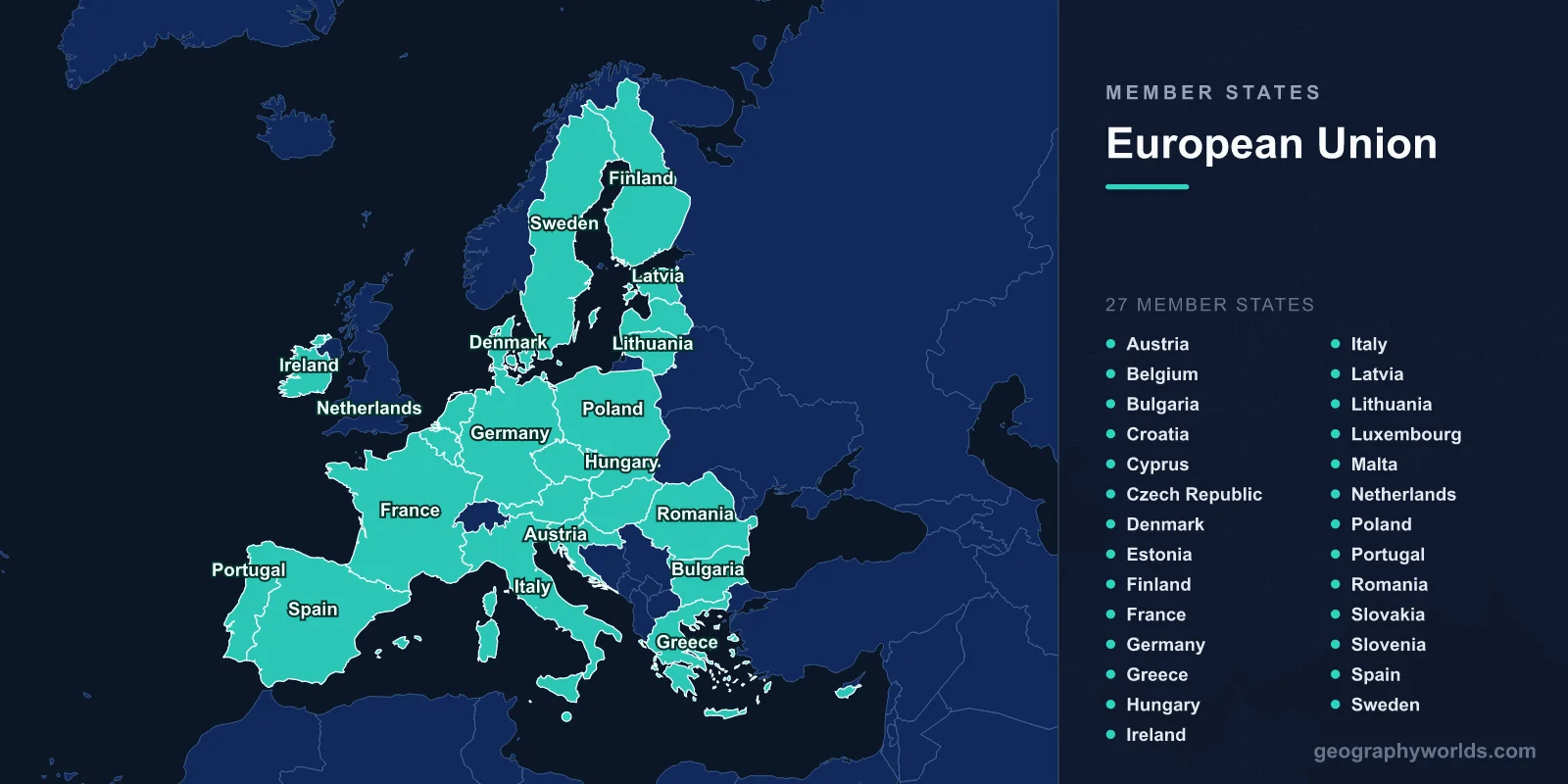
Complete Reference Table of All 27 EU Member States in 2026
Its most recent addition is Croatia, which joined in July 2013, while the United Kingdom became the only member state to leave when its withdrawal took effect on 31 January 2020.
Geographically, the bloc stretches from the Arctic Circle in northern Finland and Sweden down to the Mediterranean islands of Cyprus and Malta, and from the Atlantic coast of Ireland and Portugal to the eastern borders of Poland, Slovakia, Hungary, and Romania. Across this territory, member states pool sovereignty in key areas to operate a single internal market where goods, services, capital, and citizens move freely across national borders.
The table below lists all 27 member states along with their capital cities, approximate populations, land areas in square kilometres, and the year each joined the union. Currency and Schengen details are grouped directly below the table:
- Founding six (1957): Belgium, France, Germany, Italy, Luxembourg, and the Netherlands signed the Treaty of Rome.
- Eurozone members (21): Every EU country uses the euro (€) except six: Czechia (koruna), Denmark (krone), Hungary (forint), Poland (zloty), Romania (leu), and Sweden (krona). Bulgaria adopted the euro on 1 January 2026.
- Schengen Area status (25 of 27): Every EU member state is in the border-free Schengen zone except Ireland (opt-out) and Cyprus (pending evaluation), after Bulgaria and Romania became full air, sea, and land members on 1 January 2025.
Complete reference table of the 27 European Union member states with capitals, populations, areas, and accession years.
| Country | Capital | Population & Area | Joined EU |
|---|---|---|---|
| Austria | Vienna | 9.2M · 83,879 km² | 1995 |
| Belgium | Brussels | 11.8M · 30,528 km² | 1957 (founding) |
| Bulgaria | Sofia | 6.4M · 110,994 km² | 2007 |
| Croatia | Zagreb | 3.9M · 56,594 km² | 2013 |
| Cyprus | Nicosia | 0.9M · 9,251 km² | 2004 |
| Czechia | Prague | 10.9M · 78,871 km² | 2004 |
| Denmark | Copenhagen | 6.0M · 42,952 km² | 1973 |
| Estonia | Tallinn | 1.4M · 45,339 km² | 2004 |
| Finland | Helsinki | 5.6M · 338,462 km² | 1995 |
| France | Paris | 68.4M · 551,695 km² | 1957 (founding) |
| Germany | Berlin | 83.4M · 357,592 km² | 1957 (founding) |
| Greece | Athens | 10.4M · 131,957 km² | 1981 |
| Hungary | Budapest | 9.6M · 93,030 km² | 2004 |
| Ireland | Dublin | 5.3M · 70,273 km² | 1973 |
| Italy | Rome | 59.0M · 302,073 km² | 1957 (founding) |
| Latvia | Riga | 1.9M · 64,589 km² | 2004 |
| Lithuania | Vilnius | 2.9M · 65,286 km² | 2004 |
| Luxembourg | Luxembourg City | 0.67M · 2,586 km² | 1957 (founding) |
| Malta | Valletta | 0.56M · 316 km² | 2004 |
| Netherlands | Amsterdam | 17.9M · 41,543 km² | 1957 (founding) |
| Poland | Warsaw | 36.6M · 312,679 km² | 2004 |
| Portugal | Lisbon | 10.6M · 92,225 km² | 1986 |
| Romania | Bucharest | 19.1M · 238,397 km² | 2007 |
| Slovakia | Bratislava | 5.4M · 49,035 km² | 2004 |
| Slovenia | Ljubljana | 2.1M · 20,273 km² | 2004 |
| Spain | Madrid | 48.6M · 505,990 km² | 1986 |
| Sweden | Stockholm | 10.6M · 438,574 km² | 1995 |
From Six Founding Nations to 27 Members: How the Bloc Expanded
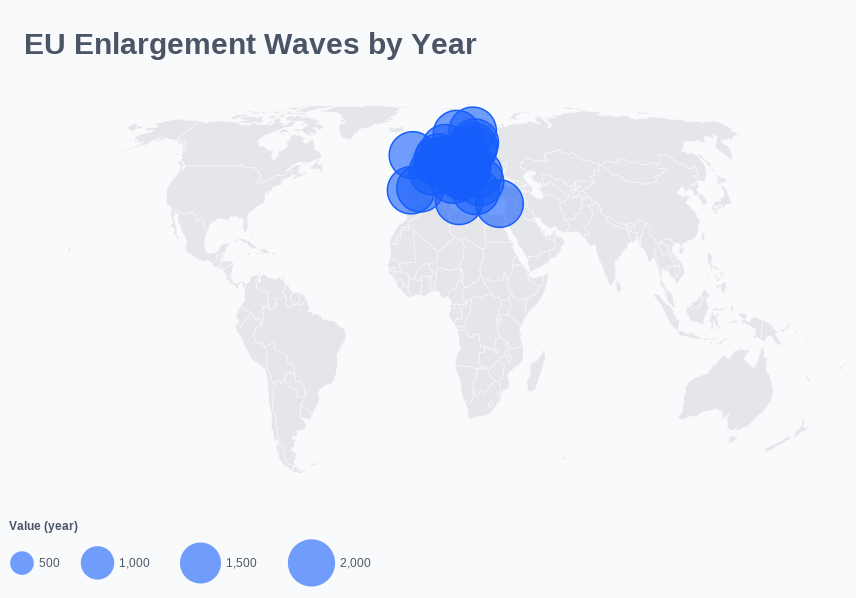
European integration began after World War II to bind neighbors so closely together in trade and industry that armed conflict between them would become impossible. Those same six nations signed the Treaty of Rome in 1957 to establish the European Economic Community and a shared common market.
In 1992, the Maastricht Treaty formally created the European Union, established shared EU citizenship, and set the rules for a single currency.
- 1957 Founding Six: Belgium, France, Germany, Italy, Luxembourg, and the Netherlands formed the original community.
- 1973 First Enlargement: Denmark, Ireland, and the United Kingdom joined the bloc.
- 1981 and 1986 Mediterranean Enlargements: Greece entered in 1981, followed by Portugal and Spain in 1986.
- 1995 Enlargement: Austria, Finland, and Sweden joined after the Cold War.
- 2004 Eastern and Mediterranean Expansion: Cyprus, Czechia, Estonia, Hungary, Latvia, Lithuania, Malta, Poland, Slovakia, and Slovenia joined in the largest single expansion.
- 2007 and 2013 Enlargements: Bulgaria and Romania joined in 2007, followed by Croatia on 1 July 2013.
Before any new country can join, it must satisfy the Copenhagen criteria, a strict set of conditions agreed upon in 1993. An applicant state must demonstrate stable institutions guaranteeing democracy, the rule of law, and human rights, alongside a functioning market economy and the administrative capacity to adopt the entire body of European Union law. Additionally, existing member states must unanimously approve every new accession treaty.
While non-sovereign territories have left the community in the past (French Algeria upon independence in 1962, and Greenland by home-rule referendum in 1985 while remaining part of the Kingdom of Denmark), the United Kingdom is the only sovereign member state ever to withdraw.
Following its June 2016 referendum, the UK triggered Article 50 of the Treaty on European Union and formally left the bloc on 31 January 2020 after 47 years of membership.
Comparing the EU, the Eurozone, and the Schengen Area
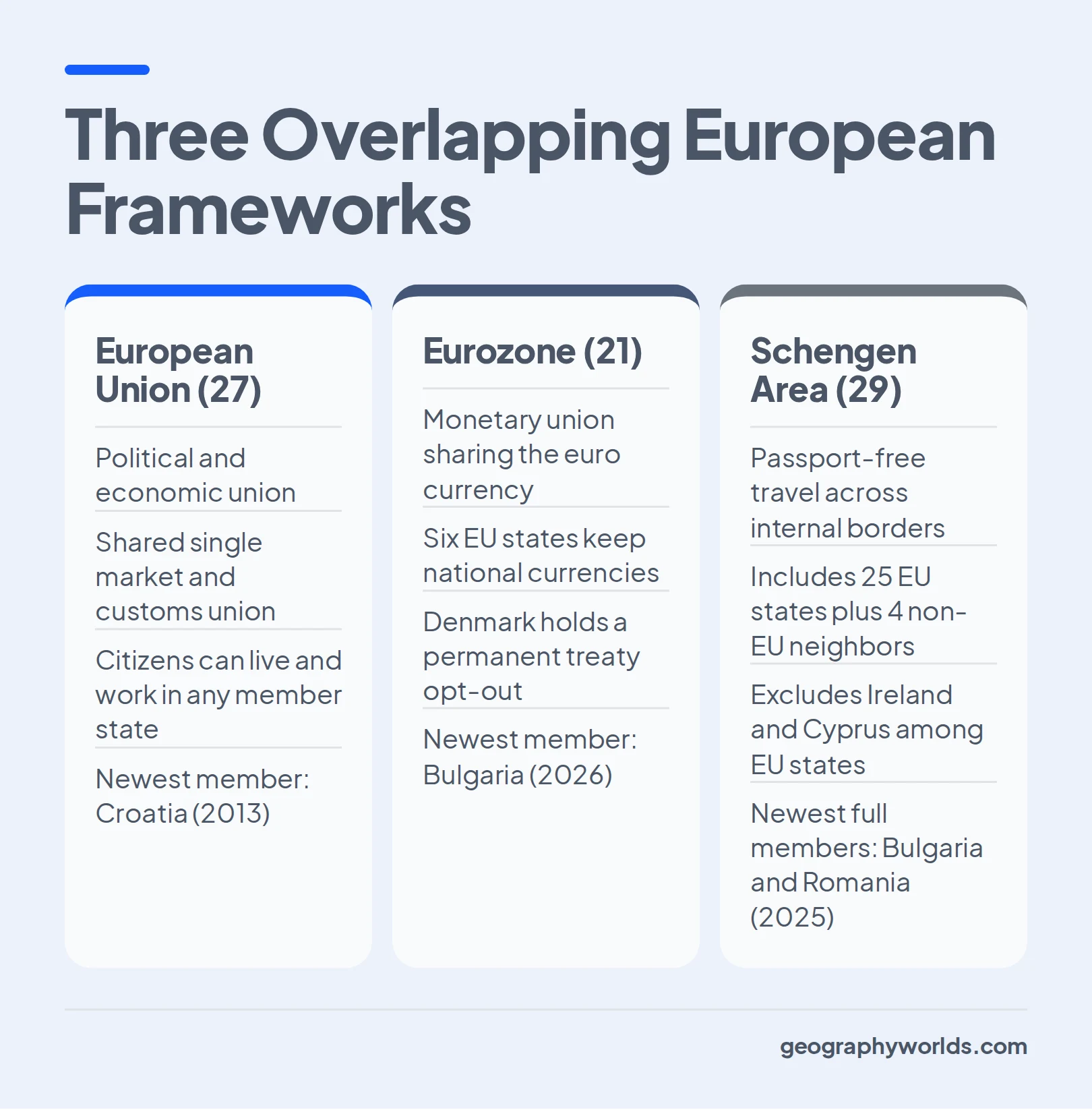
Travelers and geography students frequently mix up the European Union, the Eurozone, and the Schengen Area. Instead of a single uniform bloc, these treaties form three overlapping circles across the continent.
The Eurozone: 21 Euro Countries and Six National Currencies
Following Croatia's entry in 2023 and Bulgaria's adoption on 1 January 2026, 21 of the 27 EU nations use the single currency. Six EU member states continue to issue their own national currencies:
- Danish krone (DKK): Denmark holds a permanent treaty opt-out from joining the single currency, though its krone is pegged closely to the euro.
- Swedish krona (SEK): Sweden has not joined the exchange-rate mechanism required before adopting the euro.
- Polish zloty (PLN): Poland retains its national currency as the largest non-euro economy inside the EU.
- Czech koruna (CZK): Czechia continues to use the koruna for domestic transactions.
- Hungarian forint (HUF): Hungary maintains its own central bank rate and national currency.
- Romanian leu (RON): Romania plans to adopt the euro once it meets all fiscal convergence targets.
Under EU treaties, all member states except Denmark are legally committed to adopting the euro eventually once they fulfill the Maastricht convergence criteria. These rules require low inflation, sustainable government deficits and public debt levels, stable long-term interest rates, and at least two years of currency stability inside the European Exchange Rate Mechanism (ERM II).
The Schengen Area: 29 Countries Without Border Controls
The Schengen Area is the passport-free travel zone encompassing 29 European countries: 25 EU member states plus four non-EU neighbors (Iceland, Liechtenstein, Norway, and Switzerland). Bulgaria and Romania lifted air and sea border checks in March 2024 and completed full land-border integration on 1 January 2025. Only two EU members remain outside Schengen: Ireland maintains an opt-out to preserve its Common Travel Area with the United Kingdom, while Cyprus is still completing technical evaluations to join.
Tip: Being inside the Schengen Area does not mean a country is in the European Union or the EU customs union. When crossing by road from Germany or Austria into Switzerland, or from Sweden into Norway, you pass no routine passport control, but customs officers still enforce goods and duty limits.
European Countries Outside the EU: The UK, EFTA States, and Candidates
Roughly 50 sovereign countries lie wholly or partly on the European geographic continent, meaning more than 20 European states sit outside the European Union. Most fall into four clear groups based on their treaties and accession progress with Brussels.
Former Member and EFTA Partners
The United Kingdom is the only sovereign state to have left the EU, ending 47 years of membership when Brexit took effect in 2020 and trading with the bloc today under a Trade and Cooperation Agreement. Four other Western and Northern European nations belong to the European Free Trade Association (EFTA) rather than the EU: Iceland, Liechtenstein, Norway, and Switzerland. All four EFTA countries belong to the Schengen Area, and three (Iceland, Liechtenstein, and Norway) participate directly in the EU single market through the European Economic Area (EEA), while Switzerland governs its access through bilateral treaties.
Official Candidate Countries and Microstates
Nine countries hold official candidate status to join the European Union, working to align their judicial systems, economies, and domestic laws with EU standards. In the Western Balkans, Montenegro, Albania, North Macedonia, Serbia, and Bosnia and Herzegovina are in various stages of accession talks, while Kosovo is recognized as a potential candidate. In Eastern Europe and the Caucasus, Ukraine and Moldova became official candidates in 2022, followed by Georgia in 2023, while Turkey's long-standing application has remained stalled since 2018.
Five European microstates also lie outside the union: Andorra, Monaco, San Marino, Vatican City, and Liechtenstein. Although Andorra, Monaco, San Marino, and Vatican City are not EU or Eurozone members, all four have signed formal monetary agreements that allow them to use the euro as their official currency and mint limited sets of their own euro coins.
In addition to formal agreements, two Balkan nations outside the EU, Montenegro and Kosovo, unilaterally adopted the euro as their de facto domestic currency when physical euro banknotes and coins launched in 2002, having previously used the German mark. Neither country has a formal monetary agreement with the European Central Bank or minting rights, meaning their use of the currency is distinct from Eurozone membership.
European countries outside the European Union grouped by their relationship to the bloc.
| Category | Countries Included | Single Market & Travel Relationship |
|---|---|---|
| Former EU Member | United Kingdom | Trade and Cooperation Agreement; Common Travel Area with Ireland |
| EFTA & EEA States | Iceland, Liechtenstein, Norway | Inside the EU single market and Schengen Area; outside the customs union |
| EFTA Bilateral Partner | Switzerland | Inside the Schengen Area; bilateral single market access |
| Official EU Candidates | Albania, Bosnia and Herzegovina, Georgia, Moldova, Montenegro, North Macedonia, Serbia, Turkey, Ukraine | Negotiating alignment with EU laws and standards |
| Euro-Using Microstates | Andorra, Monaco, San Marino, Vatican City | Use the euro by formal monetary agreement; open borders with EU neighbors |
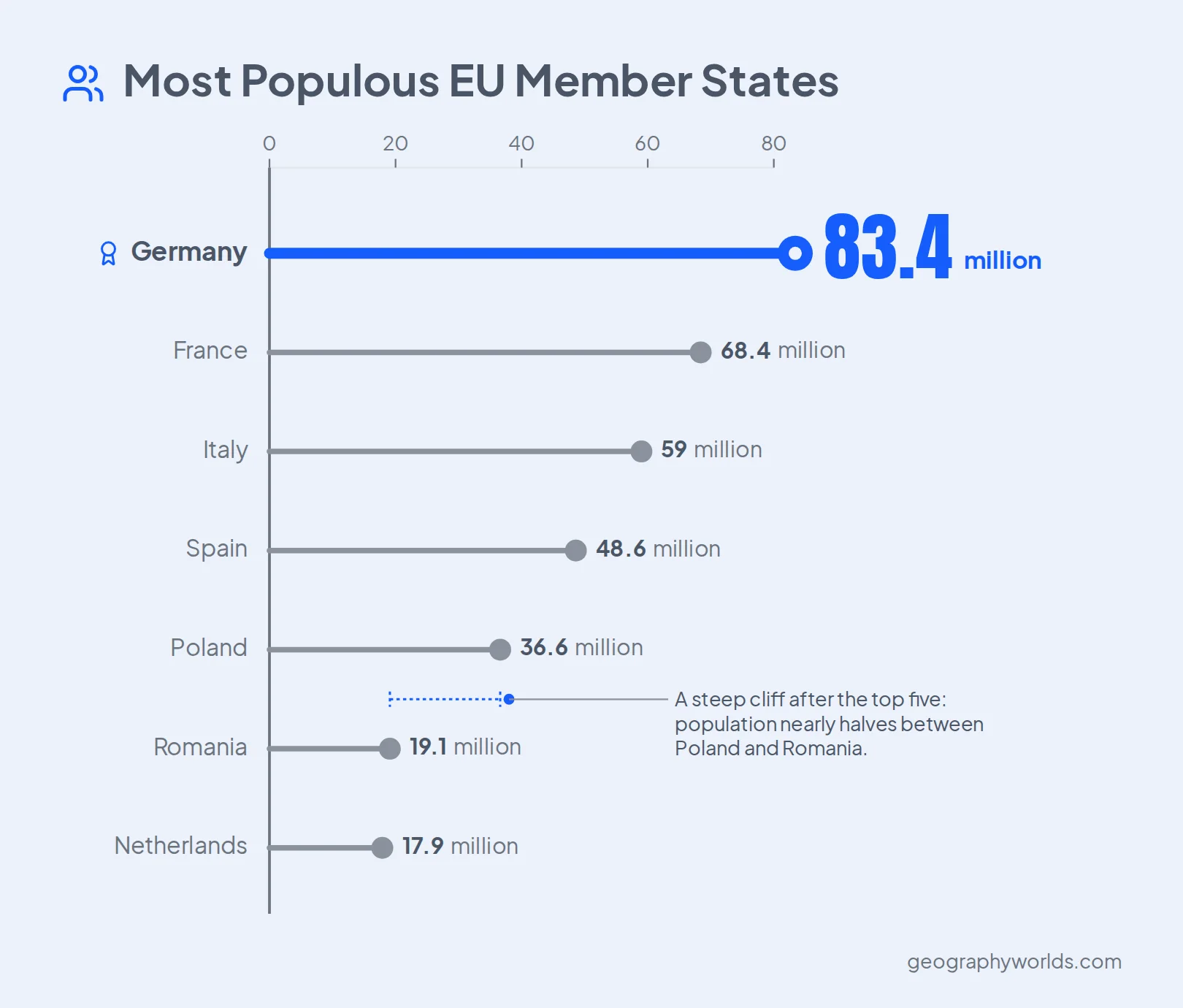
Population and Land Area Across the European Union
Combined, the 27 member states cover roughly 4.23 million km² and are home to nearly 450 million residents, making the EU the third-largest population bloc in the world after India and China. Individual member states vary enormously in size, ranging from over 83 million residents in Germany to just over half a million in Malta.
A handful of large nations account for the majority of the union's territory and people:
- Largest by population: Germany leads the bloc at roughly 83.4 million people, followed by France (68.4 million), Italy (59.0 million), Spain (48.6 million), Poland (36.6 million), Romania (19.1 million), and the Netherlands (17.9 million).
- Largest by land area: France is the largest member state by total area (around 551,695 km² in metropolitan Europe, plus overseas departments), followed by Spain (505,990 km²) and Sweden (438,574 km²).
- Smallest by area and population: The Mediterranean archipelago of Malta is the smallest member state on both counts, covering just 316 km² with about 563,000 inhabitants, followed in both rankings by Luxembourg (2,586 km² and 672,000 residents).
While Malta and the Benelux nations rank among the most densely populated areas in Europe, northern Sweden and Finland contain vast stretches of boreal forest and arctic tundra with just a few inhabitants per square kilometre.
Furthermore, the European Union's legal territory extends beyond the European continent through outermost regions such as French Guiana in South America, Guadeloupe and Martinique in the Caribbean, Réunion and Mayotte in the Indian Ocean, and the Canary Islands, Madeira, and the Azores in the Atlantic.
Watch out: Do not confuse the largest country wholly in Europe with the largest country in the European Union. Ukraine covers about 603,550 km² (making it larger than metropolitan France), and European Russia is larger still, but neither is an EU member state.
Practice European Capitals, Borders, and Subnational Regions
Memorizing national capitals, land outlines, and regional borders is much easier with active recall and immediate feedback than by passively reading a table. All basic quizzes run directly in your browser on desktop or tablet with no account or app download required.
Once you know the 27 member states and their capitals, challenge yourself to learn them all across national and regional map games:
- Capital and Regional Quizzes: Test your knowledge of country capital cities across multiple difficulty levels in the Capital Quiz (which gives 10 multiple-choice questions per round) or focus on specific parts of the globe with Regional Geography Quizzes.
- Borders and Outlines: Connect two distant countries by picking consecutive bordering nations along the shortest land route in Country Chain, or identify countries solely by their land outlines in the Premium Country Shape Quiz.
- Subnational Country Games: Dive inside major EU member states with our subnational country games, which feature 4 games each for Germany's 16 states, Italy's 20 regions, France's 13 regions, Spain's 19 regions, Poland's 16 voivodeships, and the Netherlands' 12 provinces.
Test Your European Geography!
Think you know world geography? Try our interactive geography quiz!
Play Geography Games →