

France is a country of about 69.1 million people (2026 estimate) whose most surprising facts start with its shape: counting its overseas regions it uses 12 time zones, more than any other country, and its longest land border is not with Spain or Germany but with Brazil, through French Guiana. It received 102 million foreign visitors in 2025, more than any other country; the summit of Mont Blanc, its highest point, changes height from one survey to the next; 70% of its electricity comes from nuclear power; and a French train has run at 574.8 km/h.
France’s Longest Border Runs Through the Amazon
Metropolitan France, the part in Western Europe, covers about 551,500 km², the largest area of any European Union member. Its continental core is roughly 1,000 km from north to south and the same from east to west, and its land borders run past Belgium, Luxembourg, Germany, Switzerland, Italy, Monaco, Andorra and Spain. Most of those frontiers follow natural lines: the Pyrenees in the south, the Alps and the Jura in the southeast, and the Rhine in the east.
The France most people picture is only part of the state, though. With its overseas departments and territories, the total land area rises to 643,801 km². The largest overseas piece is French Guiana on the north coast of South America, with a land area of 83,534 km², about one-seventh the size of European France. About 98.9% of it is forest, much of it primeval rainforest, and its population was 298,554 in January 2026, half of them in Cayenne. The Brazil–France border between French Guiana and the Brazilian state of Amapá is 730 km long, which makes it France’s longest frontier with any country. The border with Spain comes second at 623 km. A single bridge crosses it, over the Oyapock River between Saint-Georges and Oiapoque.
Islands spread across three oceans also explain the time-zone record. Metropolitan France keeps Central European Time, but the overseas territories, from Saint Pierre and Miquelon off Canada to French Polynesia in the Pacific, add 11 more. That makes 12 time zones, or 13 if the French claim to Adélie Land in Antarctica is counted. France has applied the rules of the Antarctic Treaty there since 1961, and the treaty’s Article 4 governs such claims. The same islands give France the world’s second-largest exclusive economic zone, 11,035,000 km² of sea, roughly 8% of the area of all the world’s EEZs combined.
Mont Blanc Has No Fixed Height
France’s highest summit sits on the Franco-Italian border above Chamonix, and it cannot be given one exact height. The top of Mont Blanc is a thick dome of ice and snow, and the dome grows and shrinks. For a long time the official figure was 4,807 m. A GPS survey by the French mapping agency IGN in 2002 measured 4,807.40 m. After the 2003 heatwave a team of 21 surveyors, glaciologists and guides found 4,808.45 m, with the highest point shifted 75 cm from where it had been the year before. Since then the summit has been surveyed every two years. The 2005 survey found 4,808.75 m, and the 2007 survey found 4,807.9 m.

The rock beneath the ice is lower. The 2005 survey placed the rock summit at 4,792 m, about 40 m west of the snow-covered top. Whichever figure is used, Mont Blanc is the highest mountain in Europe outside the Caucasus and the second-most prominent peak in Europe after Mount Elbrus. Ownership of the summit area has long been disputed between France and Italy. Two more landmarks belong to the massif. The 11.6 km Mont Blanc Tunnel, drilled between 1959 and 1962 and opened to traffic on 19 July 1965, runs under the massif from France to Italy, and Chamonix, at its foot, hosted the games of 1924 that the International Olympic Committee later recognised as the first Winter Olympics. For a side-by-side look at the massif against Africa’s highest peak, see our Kilimanjaro vs Mont Blanc comparison.
Lascaux, Massalia and the Treaty of Verdun in 843
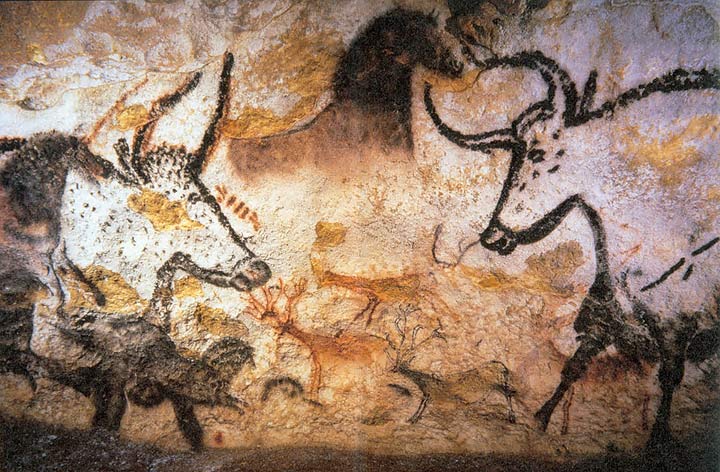
People were painting in France long before there was a France. The Lascaux cave near Montignac in the Dordogne holds more than 600 wall paintings, mostly of large animals. Of the 605 images identified precisely, 364 show horses and 90 show stags, with aurochs and bison making up about 4 to 5% each. They are usually dated to between 17,000 and 22,000 years ago. The original cave has been closed to the public since 1963, after the carbon dioxide, heat and humidity from about 1,200 visitors a day had visibly damaged the paintings, and Lascaux joined the UNESCO World Heritage List in 1979.
France’s oldest city is Greek in origin. Greek settlers from Phocaea founded Massalia, today’s Marseille, around 600 BC. Rome took southern Gaul around 125 BC and called it Provincia Nostra, “Our Province”, which survives in the name Provence. Julius Caesar conquered the rest of Gaul and defeated the revolt led by Vercingetorix in 52 BC. When Roman power faded, the Franks moved in, and Gaul became Francia, the “land of the Franks”. Our article on why France is called France follows that name back through Latin. The country’s borders began to take shape with the Treaty of Verdun in 843, which split Charlemagne’s empire among his three grandsons. The western share, West Francia, became the Kingdom of France. Hugh Capet was crowned in 987, and from 1190 his descendants were called “kings of France” rather than “kings of the Franks”.
What 1789 Gave the World: Rights, Metres and a Civil Code
The French Revolution began with the Estates General in May 1789 and the storming of the Bastille on 14 July. Within weeks the Assembly had adopted the Declaration of the Rights of Man and of the Citizen, which is still the constitutional guarantee of freedom of religion in France today. It also had a violent phase. About 16,000 people were executed in the Reign of Terror before it ended in July 1794. Napoleon seized power in a coup in 1799. Even after the defeats of 1812 to 1815, three things from those years outlived his empire across Europe: the metric system, the Napoleonic Code of civil law, and the Revolution’s ideas of equal rights.
The current constitution is not France’s first. The Fifth Republic, a semi-presidential system with a strong president, dates from a 1958 referendum led by Charles de Gaulle. It replaced the Fourth Republic of 1946–1958, which collapsed during the Algerian War. France has been a recognised nuclear-weapons state since 1960.
69 Million People, One Very Large Capital
With an estimated 69.1 million people in 2026, France is the third-most populous country in Europe and the second in the EU. What stands out is how unevenly that population is spread among its cities. The Paris metropolitan area had 13.3 million residents in 2023, more than the next five French metropolitan areas put together.
For much of the 21st century France has had more births than most developed countries, but that has slowed. The fertility rate fell to 1.56 children per woman in 2025, the lowest since the end of the First World War. Life expectancy at birth is 82.7 years, and about one French person in five is 65 or older. Immigration has shaped the country for a long time. Between 1921 and 1935 alone, about 1.1 million net immigrants arrived, and around 1.6 million pieds-noirs returned from North Africa in the 1960s. Because a 1958 constitutional principle bars the state from collecting data on ethnicity, most estimates of ancestry come from surveys rather than the census.
102 Million Visitors and an Iron Tower That Held a Record for 41 Years
France is the world’s top tourist destination, with 102 million international arrivals in 2025. It earns less from tourism than that number suggests, ranking third for tourism receipts behind the United States and Spain, and only fifth for hotel nights, because many visitors cross France on the way elsewhere and do not stay in hotels. The country has 54 UNESCO World Heritage Sites, the fourth-highest total of any country. The Louvre is the most visited art museum in the world, with 7.7 million visitors in 2022. Away from Paris, the French Riviera draws more than 10 million tourists a year and the châteaux of the Loire Valley about 6 million.
The Eiffel Tower was not meant to last as long as it has. Gustave Eiffel’s company built it between 1887 and 1889 as the centrepiece of the 1889 World’s Fair, held for the centenary of the Revolution. Many of France’s leading artists criticised it at the time. At 330 m, it overtook the Washington Monument as the tallest human-made structure in the world and kept that title for 41 years, until New York’s Chrysler Building was finished in 1930. It was also the first structure to pass both 200 m and 300 m. It had 5.9 million visitors in 2022.
56 Reactors, 46 °C and a 574.8 km/h Train
After the 1973 oil crisis, France chose nuclear power for its energy security. It now has 56 operating reactors, the second-highest number of any country, and nuclear plants generate about 70% of its electricity, by far the highest share in the world. Hydropower is the largest renewable source and supplies about 13% of electricity.
France also holds the world speed record for a train on steel wheels. On 3 April 2007, a specially modified TGV reached 574.8 km/h on the new LGV Est line east of Paris. Normal TGV services run at up to 320 km/h. The first TGV prototype, TGV 001, reached 318 km/h in 1972. The country’s weather records are more recent and more worrying. On 28 June 2019, the village of Vérargues in the south recorded 46 °C, the highest temperature measured in metropolitan France since records began.
Literature gives France one more record. Counted by language, writers in French have won 16 Nobel Prizes in Literature, second only to those writing in English, from Sully Prudhomme in 1901 onward. France is therefore both a European country and a global one, with land in South America, islands in every ocean and a single city that holds nearly a fifth of its people. To see how the rest of that urban map fits together, our guide to the largest cities in France ranks each one.