

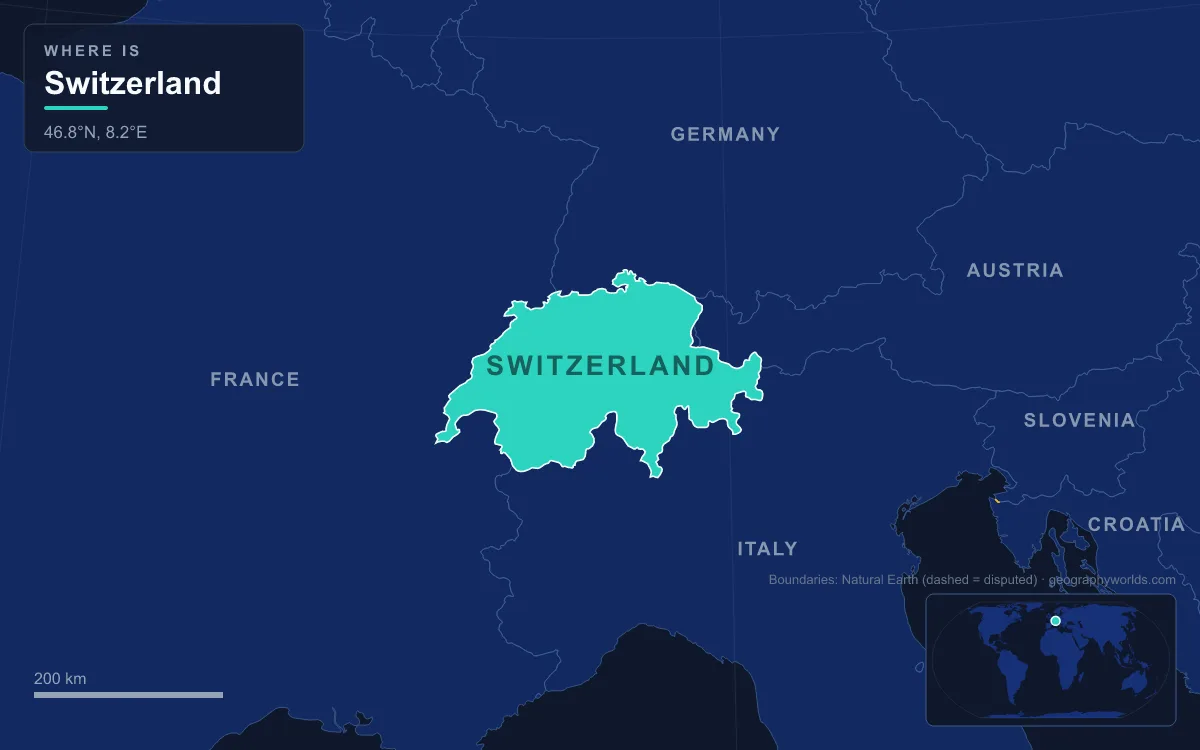
Switzerland is a landlocked federal republic of about 9 million people (June 2024) spread over 41,291 km² of Central Europe, with Bern as its federal city and seat of government. It has four national languages (German, French, Italian and Romansh), 26 cantons, and mountains across roughly 60% of its land, topped by the Dufourspitze at 4,634 m. It has not fought an international war since 1815, yet it hosts more international organisations than almost anywhere else, most of them in Geneva. It also runs the world's longest railway tunnel, the 57 km Gotthard Base Tunnel, opened in 2016.
The Swiss Alps: 60 per cent of the land and 48 peaks above 4,000 metres
The Alps run across the centre and south of Switzerland and cover about 60% of its territory. Forty-eight Swiss summits reach 4,000 m (13,000 ft) or more. The highest is the Dufourspitze, at 4,634 m (15,203 ft) the top of the Monte Rosa massif in the canton of Valais. It is the second-highest mountain in the Alps after Mont Blanc, and although the massif straddles the Italian border, the summit itself lies wholly in Switzerland. A party of eight climbers and three guides first reached it from Zermatt on 1 August 1855, which happens to be the Swiss national day. In 1863 the Federal Council renamed the peak, then simply called Höchste Spitze ("Highest Peak"), after Guillaume-Henri Dufour, the engineer and general whose survey produced the Dufour Map. The Matterhorn, 4,478 m and also in Valais, is better known but more than 150 m lower.
Glaciers cover between about 1,063 and 1,220 km² of the Swiss Alps, depending on the survey. The largest in the whole Alpine chain is the Aletsch Glacier in the Bernese Alps, about 23 km long (2014) and 81.7 km² in area (2011). At Konkordiaplatz, where four tributary glaciers meet, its ice was measured at up to 905 m thick. It has retreated 3.2 km since 1870. Since 2001 it has been the centre of the Jungfrau-Aletsch UNESCO World Heritage Site.
These mountains make Switzerland a water tower for the continent. The Rhine, Rhône, Inn and Ticino all rise in the Swiss Alps and drain in different directions. The springs of the Rhine and the Rhône are only about 22 km apart, but their mouths, at Rotterdam on the North Sea and in the Camargue on the Mediterranean, lie roughly 1,000 km from each other. The country has more than 1,500 lakes and holds about 6% of Europe's freshwater.
The Swiss Plateau and the Jura, where most of the 9 million live
North of the Alps, the Swiss Plateau (also called the Central Plateau) covers about 30% of the country. It sits mostly between 400 and 700 m above sea level and is hilly rather than flat. It runs from Lake Geneva in the south-west to Lake Constance and the Rhine in the north-east, and most of the largest cities are on it. Zurich, the largest, had 440,935 residents in its municipality at the end of 2025 and a metropolitan area of about 2.1 million (2020). Geneva, the second city, had 203,856 people in January 2021 within just 16 km².
The third landscape is the Jura, a sub-alpine range that marks much of the French border on the north-west side of the plateau. Its name has spread far beyond Switzerland: the Jurassic period of geological time is named after these limestone mountains. In 1979 the French-speaking north of the canton of Bern broke away to become the canton of Jura, the 23rd member of the confederation and the first new canton since 1815.
From east to west Switzerland stretches about 350 km, and from north to south about 220 km. Its nearest sea is the Gulf of Genoa, 160 km south of Chiasso. Two foreign enclaves sit inside its borders: Büsingen, which belongs to Germany, and Campione d'Italia, which belongs to Italy. Switzerland has no exclaves of its own. Each of its five neighbours gets a frontier-by-frontier entry on our page about the countries that border Switzerland.
German, French, Italian and Romansh: one country, four language regions
Switzerland has four national languages, set out in Article 4 of the Federal Constitution. German is the native language of about 62% of the population. Swiss German dialects are the everyday spoken language for many, while the Swiss variety of Standard German is used for most writing. French is spoken natively by about 22.7%, mainly in the west (the Romandy region, which includes Geneva, Vaud, Neuchâtel and Jura). Italian is the native language of about 8.2%, concentrated in Ticino and the southern valleys of the Grisons.
Romansh, spoken natively by about 0.5%, descends from the spoken Latin of the Roman Empire and survives mainly in the trilingual canton of the Grisons. It became a national language in 1938 and has been an official language for federal dealings with Romansh speakers since 1996. Ticino, with 350,986 people in 2020, is the only canton where Italian is the sole official language. Its capital is Bellinzona and its largest city is Lugano. In 2019, 68% of permanent residents said they regularly used more than one language.
The country's names follow the same layered pattern. "Switzerland" comes from Schwyz, one of the three original forest cantons, whose name is first recorded in 972. The country code CH stands for Confoederatio Helvetica, a Latin name brought into use after 1848. It recalls the Helvetii, a Gaulish tribe of the plateau, and it later gave its name to the Helvetica typeface (1960).
26 cantons and the open-air Landsgemeinde of Glarus
The confederation is made up of 26 cantons, each with its own constitution, parliament and courts. They range in size from Basel-Stadt, at 37 km², to the Grisons, at 7,105 km², and in population from about 16,000 in Appenzell Innerrhoden to 1.5 million in Zürich (2018). There were 19 cantons after the Act of Mediation in 1803 and 22 after 1815. Jura made 23 in 1979, and the 1999 constitution raised the official count to 26 by treating the former half-cantons as full cantons.
Direct democracy is taken literally in two cantons. In Appenzell Innerrhoden and Glarus, the Landsgemeinde still meets once a year in the open air, and citizens vote on laws by raising their hands in the town square. In Appenzell, a man may still show a sword or military sidearm instead of a voting card to prove he is entitled to vote.

At federal level there is no single head of state. That role belongs to the seven-member Federal Council, elected by the 246 members of the Federal Assembly. Its chair, the President of the Confederation, rotates every year and is first among equals. The constitution dates from 1848 and was completely revised in 1874 and 1999. Parliament and government share the domed Federal Palace in Bern, built in stages between 1852 and 1902. The same democracy explains one of the country's most surprising dates: because male voters had to approve it in a referendum, women gained the federal vote only in February 1971. Appenzell Innerrhoden held out until a Federal Supreme Court ruling in 1990. Our post on the government of Switzerland explains how referendums and initiatives work.
Neutrality since the Treaty of Paris in 1815
The Old Swiss Confederacy dates its founding to the Federal Charter of 1291, an alliance of the forest cantons, and its independence from the Holy Roman Empire was formally recognised in the Peace of Westphalia in 1648. Its neutrality, though, was fixed in 1815. The European powers agreed at the Congress of Vienna that Switzerland should be neutral, and the Treaty of Paris confirmed it. That makes Swiss neutrality the oldest policy of military neutrality in the world. The country has not fought a foreign war since, although it had a short civil war, the Sonderbund War, in 1847. Dufour, of the Dufourspitze, commanded the federal side.
Neutrality has never meant isolation. Switzerland joined the League of Nations in 1920 and the Council of Europe in 1963, but it joined the United Nations only in 2002. It is a founding member of EFTA and takes part in the EU single market and the Schengen Area without being an EU member. In February 2022 it adopted EU sanctions against Russia, which some commentators described as a sharp departure from its traditional stance.
Geneva's international organisations, the Red Cross and CERN
Geneva hosts the largest number of international organisations of any city. The Palace of Nations, built for the League of Nations, is now the United Nations Office at Geneva. Agencies headquartered in the city include the World Health Organization, the International Labour Organization, the International Telecommunication Union, the World Meteorological Organization, the World Intellectual Property Organization, the UN refugee agency and the UN human rights office. Outside the UN system, it is home to the World Trade Organization and the International Organization for Migration.
The Red Cross movement began here too. In February 1863 a committee of the Geneva Society for Public Welfare, prompted by Henry Dunant's book on the battlefield of Solferino, formed what became the International Committee of the Red Cross. In October that year it held an international conference in the city, and the Geneva Conventions on the treatment of wounded soldiers and prisoners take their name from Geneva. In 2014 a point beside the Dufourspitze was renamed the Dunantspitze in his honour.
Just west of the city, at Meyrin on the French border, is CERN, the European Organization for Nuclear Research. It was founded in 1954 and runs the Large Hadron Collider, the world's largest particle collider.
The Gotthard Base Tunnel and the railways under the Alps
The Alps have always split Switzerland north from south; the latest fix runs underneath them. The Gotthard Base Tunnel opened in June 2016, with full service from December. At 57.09 km it is the world's longest railway tunnel and its deepest traffic tunnel. Two single-track tubes run from Erstfeld in Uri to Giornico in Ticino, passing below Sedrun in the Grisons. It is called a base tunnel because it runs nearly flat through the base of the massif. The older Gotthard railway, opened in 1882, is a winding mountain route across the Saint-Gotthard Massif instead.

The tunnel is the centrepiece of the New Railway Link through the Alps. That programme also includes the Lötschberg Base Tunnel on the western axis and the Ceneri Base Tunnel further south, opened in September 2020. Its main purpose is to move freight on the Rotterdam–Basel–Genoa corridor off lorries and onto trains. It also brings Italian-speaking Ticino much closer in travel time to Zurich and the rest of the plateau. To see how the federal city fits into this network of cantons and languages, read our profile of Bern, the Swiss capital.