

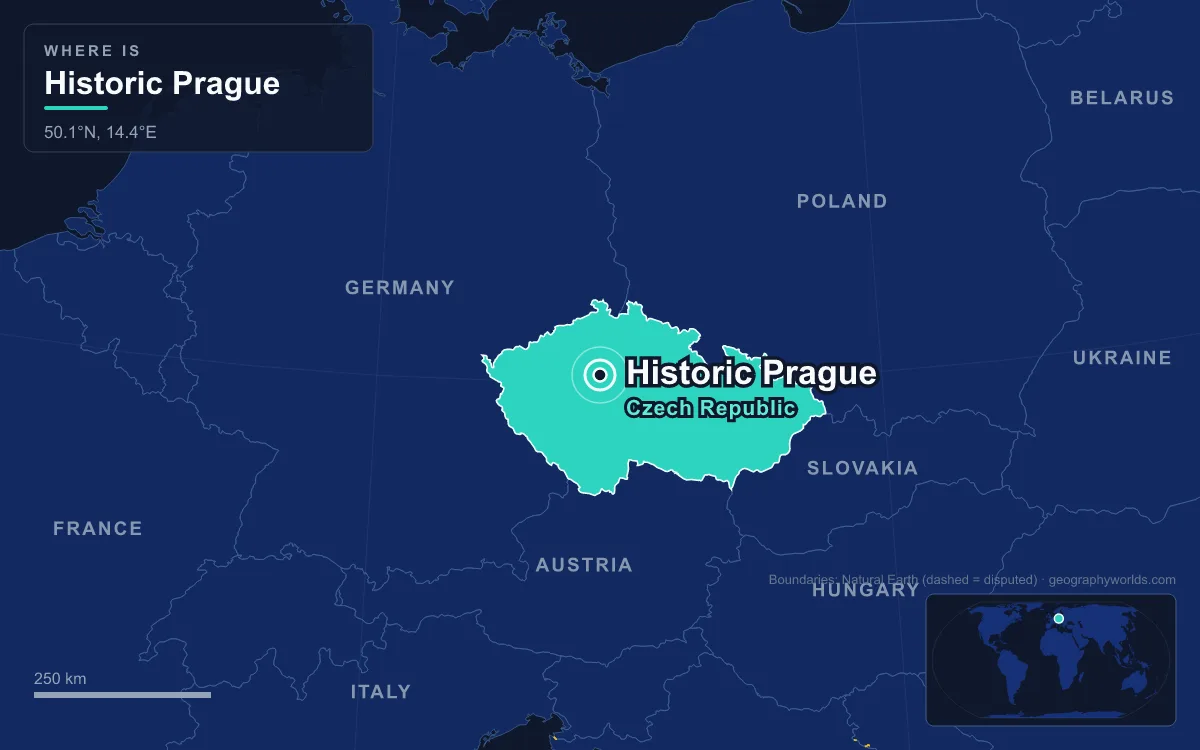
The Historic Centre of Prague is a UNESCO World Heritage Site inscribed in 1992, covering the medieval towns that make up the core of the Czech capital on both banks of the Vltava: Prague Castle and Hradčany on the hill above the left bank, Malá Strana (the Lesser Town) below it, Charles Bridge across the river, and the Old Town, the Jewish quarter of Josefov and the New Town on the right bank. It was listed at the World Heritage Committee's 16th session in Santa Fe, when the country was still Czechoslovakia, together with Český Krumlov and Telč, and passed to the Czech Republic on 1 January 1993. Its buildings span more than a thousand years, from the first church at the castle around 870 to the completion of St Vitus Cathedral in 1929, and because Prague suffered far less damage in the Second World War than other cities in the region, the layers survive side by side. The walk below goes the way most visitors do: downhill from the castle, across the bridge and into the towns beyond.
Prague Castle and Hradčany: From the 870s to the President's Seat
Prague began on the ridge above the left bank. The first walled building in the castle, the Church of the Virgin Mary, went up around 870, and the masonry beneath the castle dates from 885 at the latest. The Basilica of St George and the first church of St Vitus followed in the first half of the 10th century under Duke Vratislaus I and his son Wenceslas, the future patron saint of Bohemia. The Guinness Book of Records lists the complex as the largest ancient castle in the world: almost 70,000 square metres, about 570 metres long and 130 metres wide on average.
St Vitus Cathedral dominates the skyline. Its foundation stone was laid on 21 November 1344, when Prague became an archbishopric, and Charles IV meant it to be a coronation church, royal tomb and shrine of St Wenceslas. The first master builder, Matthias of Arras, came from the papal palace at Avignon; after his death in 1352 the 23-year-old Peter Parler took over and introduced his net vaults. Work then stalled for centuries, and the cathedral was finished only in 1929, nearly 600 years after it was begun. It measures 124 by 60 metres, and its main tower rises 102.8 metres.
The rest of the castle is a record of reigns. Vladislaus II Jagiellon began rebuilding in 1485 and added the vast Vladislav Hall; a fire in 1541 destroyed much of the complex; Rudolf II made it his main residence and housed his art collection in a new north wing. The Third Defenestration of Prague, at the castle in 1618, set off the Bohemian Revolt and the Thirty Years' War, and Swedish troops looted Rudolf's collections in 1648. Since 1918 the castle has been the seat of the head of state, first of Czechoslovakia under Tomáš Masaryk, whose architect Jože Plečnik remodelled its gardens, and since 1993 of the Czech Republic. It drew 2.59 million visitors in 2024, making it the most visited attraction in the country.
Malá Strana: Ottokar II's 1257 Town Under the Castle
Below the castle walls lies Malá Strana, literally the "Little Side" of the river. King Ottokar II founded it as a royal town in 1257 by merging the settlements under the castle, expelling many of the original residents and inviting mostly German craftsmen and merchants. It was first called the New Town beneath Prague Castle, and became the Lesser Town only in 1348, when Charles IV founded a bigger New Town across the river. Charles also extended it with a new defensive line, the Hunger Wall, built up Petřín hill between 1360 and 1362; its name dates from the famine of 1361, when work on the wall gave the city's poor a living.
Hussite forces burned the Lesser Town in 1419–1420, and the fire of 1541 killed fifty people and destroyed much of the district again. Rebuilding brought Renaissance and then Baroque palaces for the nobility, which is why Malá Strana now looks largely Baroque. Its centre is Lesser Town Square, divided into upper and lower halves by the Church of St Nicholas, built between 1704 and 1755 by Christoph Dientzenhofer and his son Kilian Ignaz, whose copper dome and bell tower were finished in 1752. It is often described as the greatest example of Prague Baroque. During the Communist era the State Security police used its tower to watch the American and Yugoslav embassies nearby.

Charles Bridge: 516 Metres of Stone Begun in 1357
From Malá Strana the walk passes under the two Lesser Town bridge towers onto Charles Bridge. A ford crossed the Vltava here long before any bridge, and the first stone bridge, the Judith Bridge built between 1158 and 1172, stood on the same line until a flood wrecked it in 1342. Charles IV began its replacement in 1357; legend says the first stone was laid at 5:31 on 9 July 1357, a palindrome of digits (1357 9 7 5 31) chosen for luck. It was completed in 1402.
The bridge is 516 metres long and nearly 10 metres wide, carried on 16 arches protected by ice guards, with the Old Town Bridge Tower on the far bank. Until 1841 it was the only way across the river, linking the castle with the Old Town on the coronation route of the Bohemian kings. It was simply the Stone Bridge or Prague Bridge until 1870, when the name Charles Bridge became official. The alley of 30 statues, most of them Baroque and set up around 1700, has been entirely replaced by replicas.
After the 1621 execution of 27 leaders of the anti-Habsburg revolt, their severed heads were displayed on the Old Town Bridge Tower. In 1648 Swedish troops fought their way onto the bridge and damaged the tower's river face. Floods damaged it in 1432, 1784 and especially on 2–5 September 1890, when logs and rafts piled against the piers and three arches collapsed; it reopened on 19 November 1892 after repairs costing 665,000 crowns. A twenty-year programme of inspection and repair began in late 2019.
Old Town and Josefov: the 1410 Orloj and the 1270 Synagogue
The Old Town grew from a riverside marketplace where a market was held every Saturday by around 1100. Its councillors bought a patrician house in 1338 to turn into the Old Town Hall, and its tower, finished in 1364, was the tallest in the city. On the south wall is the Prague Orloj, the astronomical clock first recorded on 9 October 1410 and built by the clockmaker Mikuláš of Kadaň with Jan Šindel, a Charles University astronomer. It has stopped and been repaired many times since 1552. After heavy damage in the Prague uprising of May 1945 it ran again only in 1948; the hourly Walk of the Apostles and the skeleton figure of Death were added later.
Old Town Square is ringed by the Gothic Church of Our Lady before Týn, whose two towers rise 80 metres, the Baroque Church of St Nicholas and the Kinský Palace, now part of the National Gallery. In the centre is the Jan Hus Memorial, unveiled on 6 July 1915, 500 years after the reformer was burned at Konstanz. Twenty-seven crosses in the paving in front of the town hall mark the 1621 executions.
In the north-west corner of the Old Town is Josefov, the former Jewish Town, home to one of the oldest continuously existing Jewish communities in the world; Jews made up about a quarter of Prague's population by 1708. Josefov was formally joined to the city only in 1850. Its Old-New Synagogue, completed in 1270, is Europe's oldest active synagogue and one of the earliest Gothic buildings in Prague.

New Town: Charles IV's 1348 Plan and Wenceslas Square
The walk ends in the New Town, founded by Charles IV in 1348 just outside the Old Town walls to the east and south. Charles laid the first stone of its wall on 26 March 1348, and at 7.5 square kilometres it was about three times the size of the Old Town. By 1378 Prague had well over 40,000 inhabitants, making it the fourth-largest city north of the Alps after Paris, Ghent and Bruges. Few 14th-century buildings survive here, but the street plan does, and the New Town Hall was the scene of the first Prague defenestration in the 15th century.
Its central space, Wenceslas Square, began as the Horse Market (Koňský trh) when the New Town was founded. A Baroque statue of St Wenceslas stood there from 1680, and the square was renamed in 1848. It has been the city's stage for demonstrations ever since, including the crowds of November 1989; within four years the country had split peacefully, a story told in our article on the Velvet Divorce. In 1784, under Joseph II, Hradčany, Malá Strana, the Old Town and the New Town were merged into one city, and the boundaries of those four historic towns, plus Josefov, still trace the core of the World Heritage Site.
August 2002: the Vltava Flood and Prague's Visitor Numbers Today
Ten years after the listing, the river that made Prague nearly overwhelmed it. In August 2002 the Vltava peaked at about 5,300 cubic metres per second, 20 per cent more than in the flood of 1845, in what was judged the worst flood ever to hit the capital. Karlín, Kampa, Holešovice and Libeň were the worst-hit districts, much of the metro was flooded at a cost of about 7 billion koruna, and around 40,000 people were evacuated. Malá Strana, the National Theatre and the Jewish Quarter were among the cultural sites damaged, but most of the city's artworks were moved in time.
The centre recovered and the crowds came back. In 2025 Prague recorded 8,276,026 overnight guests, 81 per cent of them from abroad, and non-residents stayed an average of 2.3 nights. After Prague Castle, the Petřín funicular on the hill above Malá Strana was the second most visited attraction in 2024, with more than 1.5 million riders, before landslide risk shut it in September 2024, ahead of a full refurbishment that began in 2025. For the modern city beyond the heritage zone, from its districts to its population of about 1.4 million, see our guide to Prague, capital of the Czech Republic.