

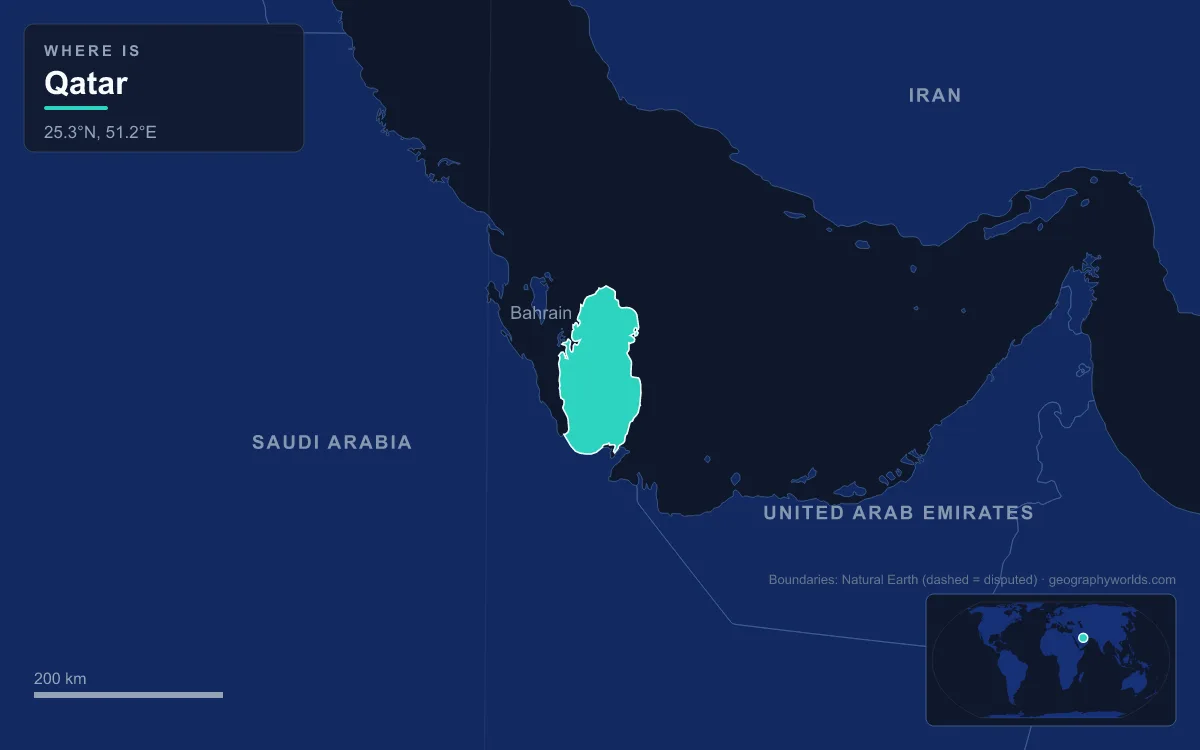
Qatar is in Asia. It occupies the Qatar Peninsula, a 160 km thumb of desert that juts north into the Persian Gulf from the eastern side of the Arabian Peninsula, and the United Nations places it in Western Asia. Its only land border, 87 km long, is with Saudi Arabia, and every one of its sea neighbours (Bahrain, the United Arab Emirates and Iran) is Asian too. Africa is a long way off: the nearest African coast, at the tip of the Horn of Africa in Somalia, is roughly 1,400 to 1,500 km away, on the far side of the Arabian Peninsula. Qatar covers 11,581 km², had about 3.18 million residents in June 2026, and has its capital at Doha.
Suez, the Red Sea and Gulf of Aden: The Line Qatar Sits East Of
The question comes up because the Middle East sits where three continents meet, and the region's shared Arabic language, desert landscapes and Islamic culture run continuously from Morocco to Oman. Culture, though, does not draw continental lines. By the usual convention, Africa ends and Asia begins at the Isthmus of Suez, the strip of land the Suez Canal now cuts from the Mediterranean to the Gulf of Suez. Farther south, the boundary follows the full length of the Red Sea, then exits via the Gulf of Aden into the Indian Ocean.
That line puts Egypt in Africa, with the Sinai Peninsula as its Asian corner, and Sudan, Eritrea, Djibouti and Somalia on the African shore. Everything on the other side, the whole Arabian Peninsula, is Asia: Saudi Arabia, Yemen, Oman, the United Arab Emirates, Qatar, Bahrain and Kuwait. Qatar does not even sit on the Red Sea side of Arabia. It lies on the Persian Gulf coast, so between Qatar and the Africa–Asia line there is the entire width of Saudi Arabia.
Geology agrees with the map. The Arabian Peninsula rides on the Arabian plate, which was part of the African plate for most of Earth's recent history. Rifting along the Red Sea began in the Eocene, and Arabia separated from Africa about 25 million years ago, in the Oligocene. Since then the Arabian plate has been moving away from Africa and pushing into the Eurasian plate, raising the Zagros Mountains of Iran directly across the Gulf from Qatar. The Red Sea is still widening today. So Qatar shares an ancient geological past with Africa, much as most of Europe once shared one with North America, but it has been on a separate, Asia-bound plate for millions of years.
To put numbers on the gap, here are great-circle distances from Doha, calculated from city coordinates. The closest Asian capitals are a short hop; the closest African points are well over a thousand kilometres away.
Measured from Qatar's southern edge rather than Doha, Cape Guardafui is about 1,400 km away and the Sudanese Red Sea coast around 1,500 km. Any journey from Qatar to Africa, by road or sea, has to pass through other Asian countries first: overland across Saudi Arabia to the Red Sea, or by sea down the Gulf, through the Strait of Hormuz and past Oman.
The Qatar Peninsula: 11,581 km² Between 24° and 27° North
Qatar's position and shape explain why it is sometimes overlooked on world maps. The peninsula lies between latitudes 24° and 27° N and longitudes 50° and 52° E, and it protrudes about 160 km into the Gulf. Its area of 11,581 km² makes it smaller than every other Gulf state except Bahrain; Kuwait, the next smallest, covers about 17,800 km².
Most of the country is a low, barren plain of sand and gravel. The highest point, Qurayn Abu al Bawl, is just 103 m above sea level, in the Jebel Dukhan, a line of low limestone outcrops that runs north to south along the west coast from Zekreet through Umm Bab to the southern border. Jebel Dukhan also holds Qatar's main onshore oil, while the great gas reserves lie offshore to the northwest. The climate is classic Arabian desert: Doha averages about 18.5 °C in January, summer temperatures often reach 40 °C, and the country receives only about 70 mm of rain a year, mostly between October and March.
In the southeast lies Khor Al Adaid, the Inland Sea: a tidal inlet of the Persian Gulf ringed by tall sand dunes. It is also where Qatar's territory meets Saudi Arabia's on the coast. The capital, Doha, is on the east coast, and more than 80% of Qatar's people live there. Of the 3,180,059 residents recorded on 21 June 2026, about 3.02 million were foreign expatriates and migrant workers, the largest groups of them from South Asia and the Philippines, which reinforces the country's Asian ties rather than African ones.
Qatar's past is Gulf history from start to finish. Pliny the Elder recorded the area's early inhabitants, the town of Zubarah on the northwest coast was founded by the Bani Utbah migrating from Kuwait in the mid-eighteenth century, and the House of Thani has ruled since Mohammed bin Thani's agreement with Britain in 1868. After Ottoman rule Qatar became a British protectorate in 1916 and gained independence in 1971.

One Land Border, Three Sea Neighbours, and the 2017–2021 Blockade
Qatar's neighbours are all Asian, and having so few of them shaped the Gulf crisis of 2017 to 2021.
Saudi Arabia, across an 87 km desert border
The Qatar–Saudi Arabia border is 87 km long. It begins on the Gulf of Salwah on the west coast and runs in four or five straight segments, forming a broad arc, to the coast of the Khor Al Adaid in the east. For a long time maps showed an Emirati panhandle reaching Qatar, but the 1974 Treaty of Jeddah between Saudi Arabia and the UAE gave Saudi Arabia the coast at Khor Al Adaid, removing any land border between Qatar and the Emirates. That left Saudi Arabia as Qatar's sole land neighbour.
The only road crossing is at Abu Samra, a settlement in Al Rayyan municipality about 90 km from Doha, named after a lone samr tree. On 5 June 2017, Saudi Arabia, the UAE, Bahrain and Egypt cut diplomatic ties with Qatar and banned Qatari aircraft and ships from their territory, citing alleged support for terrorism, which Qatar denied. Saudi Arabia closed Abu Samra, cutting Qatar's single land link and creating a de facto blockade. Qatar replaced lost supplies with imports via Iran and Turkey. In June 2018 Saudi Arabia even announced plans for a 61 km Salwa Canal along the Saudi side of the border that would have turned Qatar into an island; the project appears to have been abandoned. On 4 January 2021 Saudi Arabia agreed to reopen the border, and the al-Ula declaration signed on 5 January 2021 ended the crisis.

Bahrain, the UAE and Iran across the water
Bahrain lies just west across the Gulf of Bahrain. The two states disputed the Hawar Islands until the International Court of Justice ruled in 2001: Bahrain received the main group, although it lies only about 1.9 km from the Qatari mainland, while Qatar received little Jinan Island to the south. A planned Qatar–Bahrain Causeway stalled during the blockade and was revived in November 2023. To the southeast, the UAE is a maritime neighbour. To the north, Qatar shares with Iran the South Pars/North Dome field, by far the world's largest natural gas field, which provides most of Qatar's government revenue.
Western Asia in the UN Scheme, and in the GCC, Arab League and AFC
Every institutional grouping agrees with the map. The UN Statistics Division's M49 geoscheme places Qatar in Western Asia, the subregion that runs from Turkey and the Levant across Arabia to the Caucasus. The UN notes the scheme is for statistical convenience, but most global datasets follow it, so Qatar's figures are reported with Asia's.
- Gulf Cooperation Council. Qatar is one of the six members of the GCC, with Bahrain, Kuwait, Oman, Saudi Arabia and the UAE. The council was founded on 25 May 1981 and is headquartered in Riyadh. Every member is an Asian monarchy on the Arabian Peninsula.
- Arab League. Qatar joined on 11 September 1971, in the same enlargement as the UAE, Oman and Bahrain. The League spans both continents, from Mauritania to Iraq, so membership says nothing about continent by itself, which is one reason Gulf states get mistaken for African ones.
- Asian sport. Qatar competes as an Asian nation. Doha hosted the 2006 Asian Games from 1 to 15 December 2006, and Qatar's football team plays in the Asian Football Confederation, winning the AFC Asian Cup in 2019 and again as hosts in the 2023 edition. Qatar also hosted the 2011 Asian Cup.
Qatar is not in the African Union, which covers only African states and is the clearest institutional marker of the continent. Egypt makes a useful comparison: it straddles the Suez line, sits in the Arab League with Qatar, and was one of the four states that blockaded Qatar, yet it is treated as African because almost all of its land and people are west of the canal.
For the neighbouring case across the Gulf of Bahrain, see whether Bahrain is in Asia or Africa; for the country that really does span both continents, read how Egypt's Sinai makes it transcontinental; and for the city where most Qataris live, our guide to Doha, Qatar's capital explains how one city came to hold more than 80% of the country's people.