

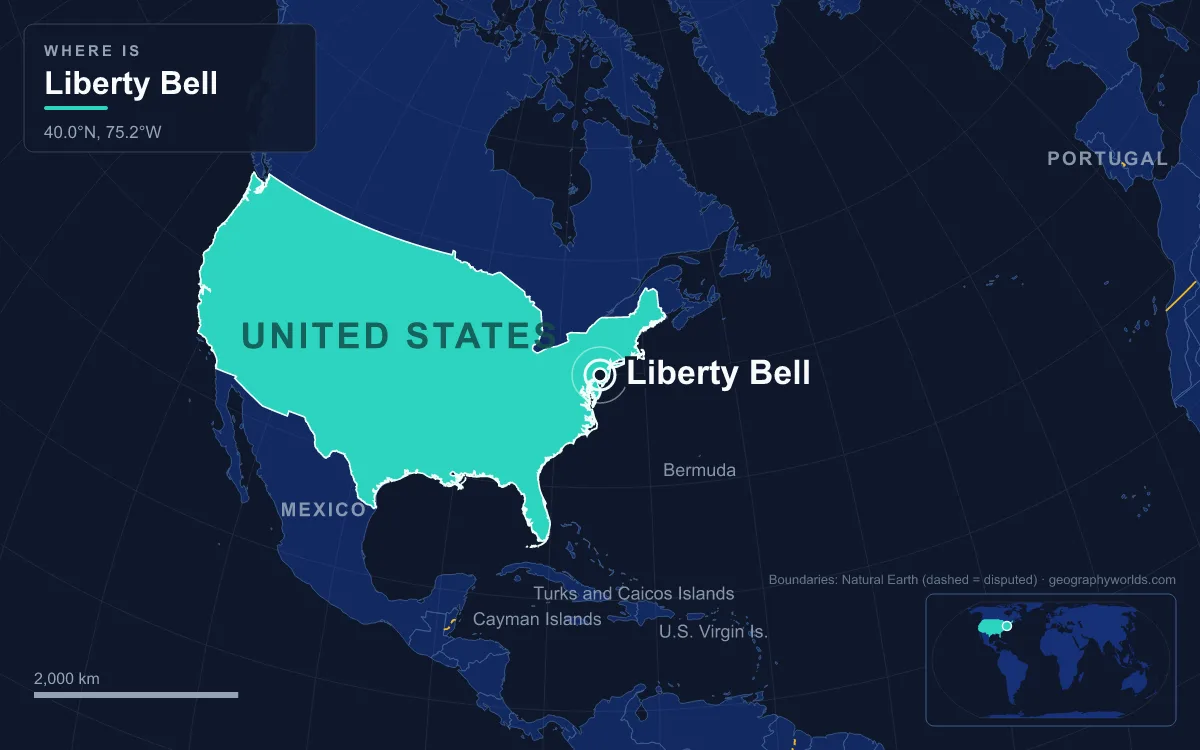
Cracked, silent and weighing about 2,080 pounds (940 kg), the Liberty Bell hangs in the Liberty Bell Center on Market Street in Philadelphia, Pennsylvania, directly across from Independence Hall, where it has been on display since 9 October 2003. It was ordered in 1751 for the Pennsylvania State House, cast in London by the firm later known as the Whitechapel Bell Foundry and delivered in 1752. It cracked the first time it was struck and was recast twice in 1753 by two local founders, John Pass of Mount Holly, New Jersey, and John Stow of Philadelphia, whose names it carries. The inscription from Leviticus 25:10, “Proclaim LIBERTY Throughout all the Land unto all the Inhabitants Thereof”, led abolitionists in the 1830s to name it the Liberty Bell, and the crack had made it unringable by February 1846. Today it is cared for by the National Park Service as part of Independence National Historical Park.
An Order to London in 1751
Philadelphia had used a bell to call citizens to proclamations and warn them of danger since William Penn founded the city in 1682; the first one hung from a tree behind the State House. In 1751, with a bell tower going up on the State House, Isaac Norris, speaker of the Pennsylvania Provincial Assembly, wrote to the colony’s agent in London, Robert Charles, asking for “a good Bell of about two thousands pound weight”. He specified the wording: the Assembly’s order for the State House “in the City of Philada 1752” and, beneath it, the verse from Leviticus about proclaiming liberty throughout the land.
Charles placed the order with Thomas Lester of Lester and Pack, the Whitechapel firm in east London, for £150 13s 8d including freight and insurance. The bell reached Philadelphia in August 1752. The spelling “Pensylvania” on it was not a mistake but an accepted variant of the time; Alexander Hamilton used it on the signature page of the Constitution in 1787.

Cracked on the First Strike, Recast by Pass and Stow
The new bell was hung on a stand to test its tone, and at the first stroke of the clapper its rim cracked. The ship that had brought it could not take it back, so two local craftsmen offered to recast it. John Pass ran the Mount Holly Iron Foundry in nearby New Jersey and came from Malta, which had a bell-founding tradition; John Stow was a brass founder only four years out of his apprenticeship. At Stow’s foundry on 2nd Street they broke the bell up, melted it and added roughly 10 percent more copper, believing the metal too brittle.
The result, ready in March 1753, did not crack, but one listener compared its sound to two coal scuttles being banged together. Mocked by the crowd at the public test, Pass and Stow took it away and recast it again. The second recasting was finished in June 1753 and hung in the State House steeple that month, though Norris admitted he did not much like its tone and ordered a second bell from London. In 1754 the Assembly decided to keep both: the new one went on the tower clock, and the Pass and Stow bell was used to summon the legislature.
Why the bell failed is still argued. The Whitechapel foundry maintained it was damaged in transit or by an inexperienced ringer. A 1975 metal analysis by the Winterthur Museum in Delaware found far more tin than in other Whitechapel bells of the period, and concluded that Pass and Stow had then added cheap, lead-rich pewter instead of pure tin, leaving an extremely brittle alloy. The bell today is about 70 percent copper and 25 percent tin, with the rest lead, zinc, arsenic, gold and silver.
Revolution: 1776 and Hiding in Allentown
The bell rang for routine business: Benjamin Franklin wrote in October 1755 that it was calling him to the Assembly, it marked the accession of George III in 1760, and by 1772 residents complained that it rang too often. The popular story that it pealed when Congress adopted the Declaration of Independence on 4 July 1776 has no evidence behind it. The Declaration was first read to the public on 8 July, when bells across the city rang, and most historians think the State House bell was probably among them, though the steeple may have been too weak to ring it.
After the American defeat at Brandywine on 11 September 1777 left Philadelphia open to the British, the bell and other city bells were taken down so they could not be melted into cannon. A guarded wagon train carried them to Bethlehem and then to Zion German Reformed Church in Allentown, where the bell was hidden under the floorboards. It came back after the British left in June 1778, was stored while the decaying steeple was rebuilt, and was hung again in 1785, ringing on Independence Day, Washington’s Birthday and election days.
Abolitionists Give It a Name
For its first eighty years it was simply the State House bell. The name came from the anti-slavery movement. In 1835 the New York Anti-Slavery Society’s Anti-Slavery Record called it “The Liberty Bell” and pointed out that the bell had not obeyed its own inscription while a sixth of the country’s inhabitants were enslaved. Its journal Liberty put the bell on its cover in 1837; in 1839 William Lloyd Garrison’s The Liberator reprinted a poem titled “The Liberty Bell”, and Boston abolitionists led by Maria Weston Chapman began an annual fundraising gift book of the same name. Frederick Douglass and others regularly quoted the Leviticus verse.
The link to 1776 came later and partly from fiction. In January 1847 the writer George Lippard published a short story in which an old bell-ringer waits for a boy to tell him that independence has been declared, then rings the bell. Benson Lossing repeated the scene as fact in 1850, and school primers carried it for generations.
Washington’s Birthday, 1846: The Crack That Silenced It
Nobody knows exactly when the large crack began. An 1837 picture in an anti-slavery publication shows no visible crack, and a National Park Service study suggests it most likely appeared between 1841 and 1845 during ringing on Independence Day or Washington’s Birthday. The widely taught version, that it split while tolling for Chief Justice John Marshall’s death in 1835, dates only from 1876 and has little evidence behind it.
The firm record comes from February 1846. Because 22 February fell on a Sunday, Washington’s Birthday was celebrated on the 23rd. The Public Ledger reported that the long-cracked bell had been “put in order” by filing the sides of the crack, but that around noon its ringing extended the fracture, leaving it “irreparably cracked and forever dumb”. The wide dark line visible today, which seems to end at “Philada” in the inscription, is that filed-out channel. A hairline crack continues beyond it, running up through “Pass and Stow”, “the Assembly” and the letters “rty” of “Liberty” to near the yoke, which is thought to be the original one, made of American elm.

Seven Journeys by Rail, 1885–1915
Once silent, the bell became an exhibit. In 1848 it was moved to the Assembly Room of the State House, by then called Independence Hall, and in 1865 it stood at the head of Abraham Lincoln’s coffin as 120,000 to 140,000 mourners filed past. For the 1876 Centennial the city chose not to repair it, casting instead a 13,000-pound replica, the Centennial Bell, now in the Independence Hall steeple.
Between 1885 and 1915 the bell went by train to seven expositions and celebrations, with extra stops so that crowds could see it. In 1885 it went to the World Cotton Centennial in New Orleans, where at Biloxi the former Confederate president Jefferson Davis spoke in its honour. In 1893 it went to the World’s Columbian Exposition in Chicago, where John Philip Sousa conducted the first performance of The Liberty Bell march for it on 4 July. It came back from Chicago with a new crack, and its watchman was caught cutting off pieces for souvenirs; by 1909 chipping had removed more than 1 percent of its weight.
The last trip was the longest. For the 1915 Panama–Pacific International Exposition in San Francisco, Philadelphia fitted a metal brace called the “spider” inside the bell. In February 1915 it was tapped with wooden mallets to send the signal opening the fair, a transmission that also inaugurated transcontinental telephone service.
Since that return it has been moved out of doors only five times, three of them for patriotic events around the First World War and twice to move house. Chicago’s 1933 petition signed by 3.4 million schoolchildren and New York’s request for the 1939 World’s Fair were both turned down.
From Independence Hall to the 1976 Pavilion
In the Second World War it was tapped on D-Day, V-E Day and V-J Day, and a plan to store it at Fort Knox was dropped after public protest. After the war the city kept ownership but handed custody to the federal government; Congress approved the transfer in 1948 and Independence National Historical Park was founded three years later. The bell became a Cold War emblem for savings bonds and a site for civil rights and Vietnam War protests in the 1960s. Whitechapel offered to recast it in 1944 and again in 1958, and was told that nobody wanted the crack removed. As the 1976 Bicentennial year began, with millions of visitors expected, the Park Service moved it into a glass-and-steel pavilion across Chestnut Street, about 180 m from Independence Hall, a site pressed for by Mayor Frank Rizzo.
The Liberty Bell Center Since 2003
The pavilion lasted 27 years. As part of a redesign of Independence Mall, architect Bernard Cywinski of the Olin Partnership team designed the larger Liberty Bell Center, which opened on 9 October 2003, hours after the bell was installed. Excavation for it uncovered remains of the President’s House, where George Washington and John Adams lived in the 1790s, and showed that people enslaved by Washington had been housed only feet from the planned entrance. After years of protest, the Park Service marked the slave quarters in the pavement with interpretive panels. Inside, visitors pass through exhibits before reaching the bell, which since a hammer attack by a visitor in 2001 hangs out of reach behind security screening, with Independence Hall framed in the glass behind it. To explore the building it rang from, read our Independence Hall guide, and for the city around it, see the geography of Philadelphia.