
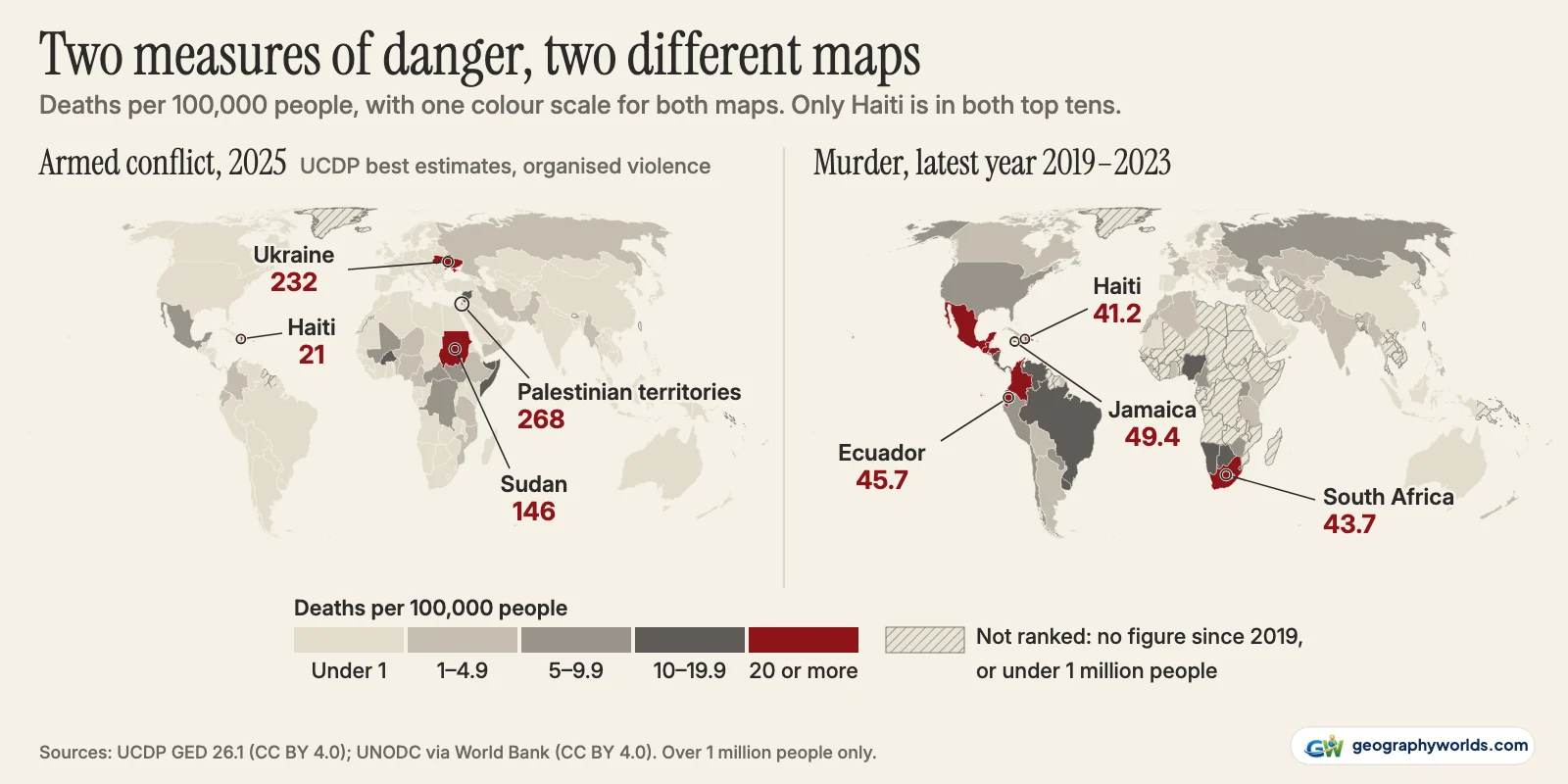
There is no single list of the most dangerous countries in 2026, because “dangerous” has no agreed definition, so this post measures two specific risks and keeps them apart: dying in armed conflict and being murdered. On conflict deaths per 100,000 people in 2025, the newest complete year, the Palestinian territories (268), Ukraine (232) and Sudan (146) rank highest. On intentional homicide per 100,000, Jamaica (49.4 in 2023), Ecuador (45.7 in 2023) and South Africa (43.7 in 2022) rank highest among countries of at least a million people. Only Haiti is in both top tens.
We do not blend the two into one score. Any composite needs a rule for how many murders equal one war death, and that rule, not the data, would pick the winner. So there are two rankings here, each with its own year and gaps.
Why the war list and the murder list barely overlap
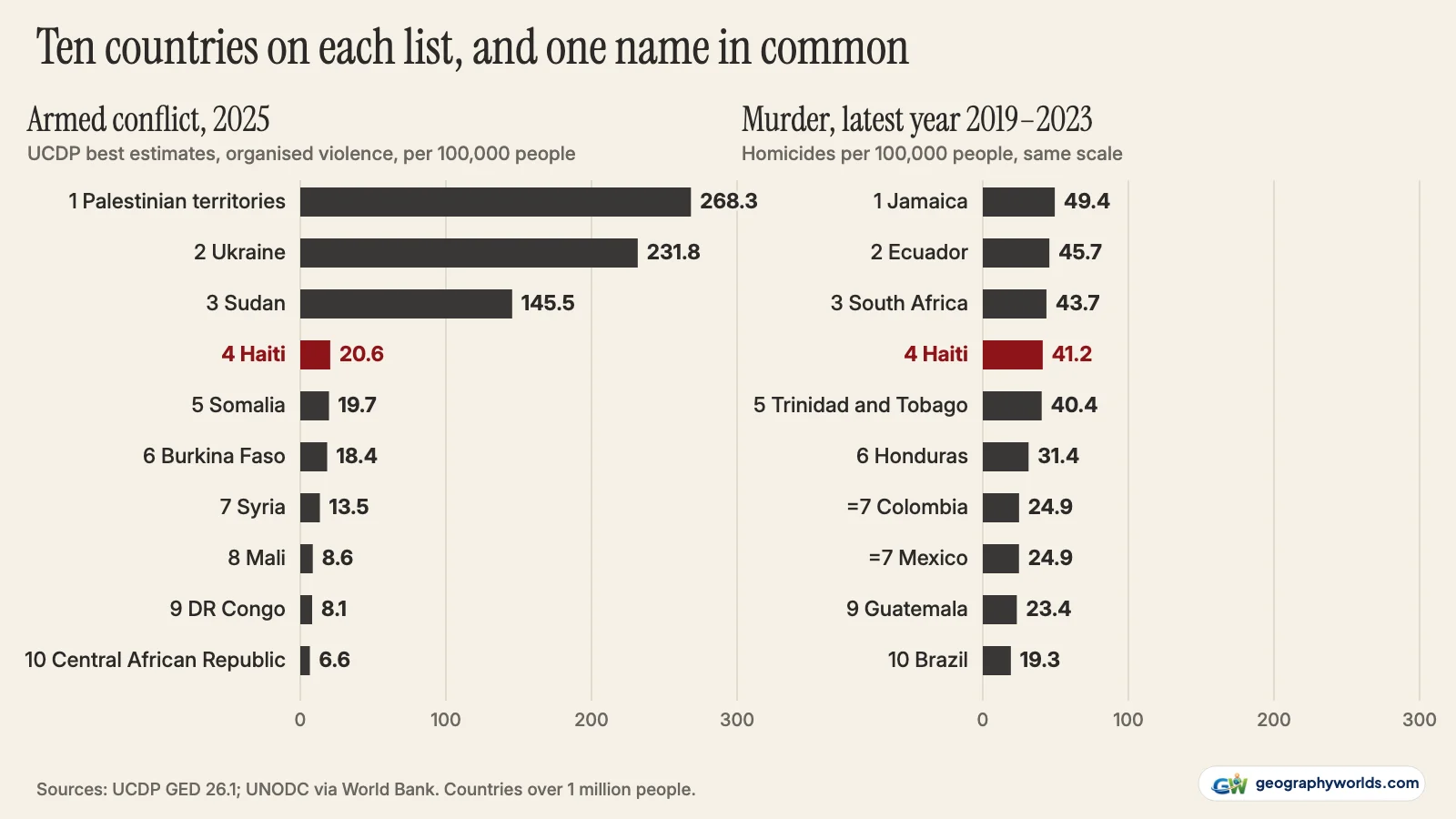
Ten countries lead each ranking, and they share one name. Widen both lists to twenty and they share four: Haiti, Mexico, Costa Rica, Ecuador. Three separate things keep them apart.
The first is definition. UNODC's homicide statistic excludes deaths arising from armed conflict by design, so a soldier killed at the front or a civilian killed by shelling should never appear in it.
The second is real geography. On the maps at the top of this page, the red of conflict falls on Ukraine and Sudan, while the red of murder runs through the Americas. Nine of the ten highest homicide rates are in Latin America and the Caribbean; South Africa is the exception.
The third is the awkward one: measurement. A homicide rate needs police, courts or death registration that still report to someone. Seven of the ten countries with the highest conflict death rates have no homicide figure from 2019 or later: Sudan, Somalia, Burkina Faso, Syria, Mali, DR Congo, Central African Republic. Their absence from the murder list says nothing about murder there.
Worldwide, murder usually kills more people than war. In 2023 the homicide rate of 5.2 per 100,000 implies about 419,000 victims, against 170,432 deaths in UCDP's conflict data that year, a ratio of 2.5 to one. UNODC's own comparison is wider, with about 440,000 homicides a year against 94,000 conflict-related deaths on average in 2019–2021, using a narrower conflict count. UCDP's total for 2025 was higher, at about 245,000 deaths.
Conflict deaths in 2025: the ranking
The Uppsala Conflict Data Program logs events one at a time, each with a place and a low, best and high death estimate. It covers fighting involving states, fighting between groups such as cartels, and one-sided killing of civilians. We summed the best estimates by the country where the deaths happened and divided by the 2025 population. UCDP files Gaza and the West Bank under Israel, a coding convention rather than a statement on status, so we split them out.
| Rank | Country | Deaths per 100,000 | Deaths, best estimate | UCDP low–high |
|---|---|---|---|---|
| 1 | Palestinian territories | 268.3 | 14,525 | 13,909–15,203 |
| 2 | Ukraine | 231.8 | 90,345 | 83,725–137,336 |
| 3 | Sudan | 145.5 | 75,174 | 20,890–90,837 |
| 4 | Haiti | 20.6 | 2,448 | 2,311–2,587 |
| 5 | Somalia | 19.7 | 3,872 | 3,808–4,535 |
| 6 | Burkina Faso | 18.4 | 4,441 | 4,370–6,319 |
| 7 | Syria | 13.5 | 3,449 | 3,141–3,753 |
| 8 | Mali | 8.6 | 2,157 | 2,062–2,750 |
| 9 | DR Congo | 8.1 | 9,172 | 8,305–29,659 |
| 10 | Central African Republic | 6.6 | 362 | 358–387 |
Population changes the order. Counted raw, Ukraine (90,345) and Sudan (75,174) stand far ahead of everyone, and the Palestinian territories (14,525) come third. Per person, the territories move to first because only about 5.4 million people live there. Nearly all of these deaths, 14,342, were in Gaza, home to about 2.1 million people, so the territory-wide rate understates Gaza and overstates the West Bank.
UCDP's event-based count for Gaza since 7 October 2023 is 61,333, well below the 71,266 reported by Gaza's Health Ministry by 29 December 2025. UCDP gives no status for 73% of the territories' deaths in 2025, so its civilian and combatant columns cannot be read as a split. Within UCDP's ranges the top two can swap: the territories run from 257 to 281 and Ukraine from 215 to 352. Population matters too. The 39.0 million is a UN projection; on the roughly 32 million Ukraine's deputy prime minister gave, its rate is about 282 and it ranks first.

Ukraine's rate is mostly soldiers, and it includes Russian soldiers killed on Ukrainian soil, so it is not the risk a resident faces. 97% of the recorded deaths were combatants. UCDP's 2,635 civilian deaths sit close to the 2,514 confirmed by the UN's monitors.
Sudan is the least certain of the three. The best estimate of 75,174 sits inside a range of 20,890 to 90,837, which means a rate anywhere from 40 to 176. 90% of the deaths are coded to North Darfur, and 62,775 are one-sided killings, mostly during and after the fall of El Fasher in October. Two events supply 56,678 of the deaths; one has a low estimate of zero, which is why the range is so wide. The UN human rights office documented more than 6,000 killings in the first three days and called the full toll undoubtedly significantly higher; UCDP's estimate for those two events draws on that report and on Yale's Humanitarian Research Lab.
Murder rates: the ranking
Homicide figures arrive later. The World Bank republishes UNODC's series, last updated in October 2026, and its newest year is 2023. We took each country's latest figure from 2019 onward, which gives 113 ranked countries. 66 of those figures are from 2023 and 47 are older, so this is a list of latest available years, not one common year.
| Rank | Country | Homicides per 100,000 | Year |
|---|---|---|---|
| 1 | Jamaica | 49.4 | 2023 |
| 2 | Ecuador | 45.7 | 2023 |
| 3 | South Africa | 43.7 | 2022 |
| 4 | Haiti | 41.2 | 2023 |
| 5 | Trinidad and Tobago | 40.4 | 2022 |
| 6 | Honduras | 31.4 | 2023 |
| =7 | Colombia | 24.9 | 2023 |
| =7 | Mexico | 24.9 | 2023 |
| 9 | Guatemala | 23.4 | 2023 |
| 10 | Brazil | 19.3 | 2023 |
Tiny states are left out because a few killings swing the rate. St Kitts and Nevis, about 47,000 people, shows 64.2 for 2023, and St Vincent and the Grenadines shows 51.3 for 2023. Both would top this table, but InSight Crime counted seven victims in St Kitts in 2025, a rate of 13.6.
Definitions shift these numbers by a point or two. InSight Crime's count for Ecuador in 2023 gives 44.5 rather than 45.7. South African police years, which run April to March, gave 43 in 2021/22 and 46 in 2022/23, either side of UNODC's 43.7.
Age matters more. Jamaica heads this table on 2023 data, yet its police recorded 1,393 murders in 2023 and 666 by late December 2025, and InSight Crime puts its 2025 rate at 23.7. Ecuador moved the other way, to a record 50.9. Those national counts are not harmonised UNODC figures, so they are not ranked, but the top of this table has already changed.
The blank pages on the murder map
Of the 158 countries with at least a million people, 45 cannot be ranked on homicide: 16 have no figure in the series at all, and 29 last reported before 2019.
| Why not ranked | Countries |
|---|---|
| No figure in the series | Chad, Congo, Côte d'Ivoire, DR Congo, Djibouti, Equatorial Guinea, Gabon, Gambia, Guinea, Laos, Libya, Madagascar, Mali, North Korea, Somalia, Togo |
| Last figure before 2019 (year) | Angola (2016), Bangladesh (2018), Benin (2017), Burkina Faso (2017), Burundi (2016), Cambodia (2011), Central African Republic (2016), Egypt (2017), Eritrea (2012), Ethiopia (2012), Guinea-Bissau (2017), Iran (2014), Iraq (2013), Lesotho (2008), Liberia (2012), Malawi (2012), Mozambique (2011), Niger (2012), Papua New Guinea (2010), Senegal (2015), South Sudan (2012), Sudan (2008), Syria (2010), Thailand (2011), Timor-Leste (2015), Turkmenistan (2015), Vietnam (2011), Yemen (2013), Zambia (2015) |
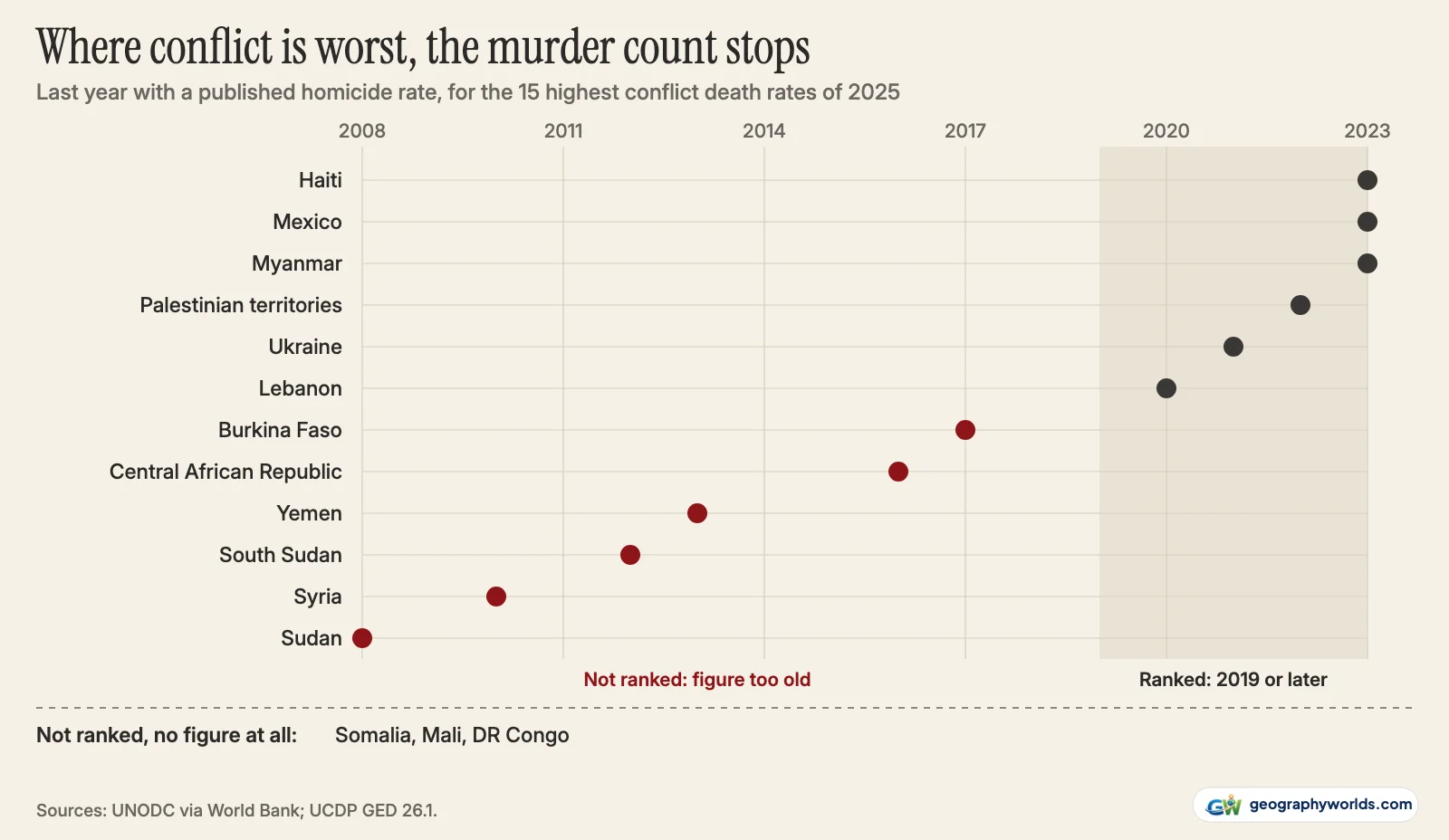
Some old figures would rank high if they were allowed in. Lesotho's last rate was 38.2 in 2008, which says little about Lesotho today. Even inside the window, some figures predate the events that matter: Ukraine's 3.8 is from 2021, before the full-scale invasion, and the Palestinian territories' latest is from 2022.
The conflict ranking has a quieter gap. UCDP gives every country a number, but it works from reports, so zero means nothing was recorded, not that nothing happened. North Korea, Eritrea and Turkmenistan all show zero. Taiwan is unranked on both maps because the World Bank series does not include it.
Haiti, fourth on both lists
Haiti's double entry is partly real and partly a boundary problem. Its gangs fit UCDP's definitions of armed groups, so 2,448 deaths in 2025 count as organised violence, a rate of 20.6. Yet many of the same kinds of killing also reach the homicide count, where Haiti stood at 41.2 in 2023. The two rates should not be added: they cover different years, and similar deaths may sit in both.
Later figures are much worse. InSight Crime reports 62 per 100,000 for 2024 and 68 for 2025 through November, on UN data that the UN itself calls a likely undercount. 84% of UCDP's Haitian deaths in 2025 were in Ouest, the department holding Port-au-Prince. Our guide to Haiti's geography covers the country itself.
Mexico shows the same overlap from the other side. UCDP's best estimate is 7,904 deaths, almost all between cartels, placing it 11th for conflict at 6.0 per 100,000, while it is joint seventh for homicide at 24.9. Those cartel deaths very likely sit inside the national homicide count too, and UCDP's low estimate is only 2,720.
What a national rate cannot tell you
These are national averages, and violence does not spread evenly. 21% of Mexico's conflict deaths were in Sinaloa and 19% in Guanajuato. Risk also differs by person: 81 per cent of homicide victims in 2021 were men and boys.
Neither ranking measures what a visitor faces, or covers road crashes, disease or disasters, which can matter more on an ordinary trip. For the opposite question, see our list of the safest countries; for travel decisions, read your government's current advisory.
What 2026 shows so far: preliminary data
UCDP's preliminary monthly events total 140,009 deaths for January to September, but 36% of those deaths carry flags for unresolved coding. Ukraine leads (64,025), then Iran (23,694). Most of Iran's figure is the January crackdown on protests, almost all still flagged; published tolls ran from the government's 3,117 to reports of at least 20,000 cited by the UN special rapporteur. Sudan's 4,229 will rise: its two largest 2025 events rest on reports published in December and February. These figures stay out of both rankings.
How these figures were built
Conflict deaths are the sum of best estimates in UCDP GED 26.1 for 2025, checked country by country against UCDP's own country-year file; homicide rates are the latest World Bank value from 2019 onward. Both rankings cover countries and territories of at least a million people, including Kosovo and the Palestinian territories, and ties at one decimal share a rank. You can download the data as a CSV, which has every low, best and high estimate, the status columns (including status unknown) and each homicide year. If you want to set one of those columns against another, Parity can draw that comparison from the spreadsheet.
- Uppsala Conflict Data Program, Georeferenced Event Dataset (GED) version 26.1: Event-level deaths, 1989–2025. CC BY 4.0. Davies et al. (2026) and Sundberg & Melander (2013), Journal of Peace Research.
- UCDP Candidate Events Dataset, January–September 2026: Preliminary, CC BY 4.0. Never ranked.
- UCDP Country-Year Dataset on Organized Violence 26.1: CC BY 4.0. Confirms our totals.
- World Bank, Intentional homicides per 100,000 people (VC.IHR.PSRC.P5), from the UNODC Data Portal: Updated 8 October 2026, CC BY-4.0. Latest year 2023.
- World Bank, Population, total (SP.POP.TOTL): CC BY-4.0. Used for every conflict death rate.
- UNODC, Global Study on Homicide 2023, executive summary: Context only.
- InSight Crime, 2025 Homicide Round-Up: Context only, not ranked.
- Natural Earth country boundaries via world-atlas (1:50m): Public domain. Map only.
Neither number answers the question alone, and a peace index gives a third answer, which is the route our history of the least peaceful countries since 2008 takes.