

Israel is a Jewish-majority country: according to its Central Bureau of Statistics, at the end of 2022 Jews made up 73.6% of the population, Muslims 18.1%, Christians 1.9% and Druze 1.6%, while the remaining 4.8% were smaller faiths such as the Baháʼí and Samaritans plus people the bureau lists as religiously unclassified. The state describes itself as "Jewish and democratic" but has no single established church. Instead it recognises 14 religious communities (Orthodox Judaism, Islam, the Druze faith, ten Christian churches and the Baháʼí Faith), and each community, not the state, controls marriage and divorce for its own members. Islam, more than 99% Sunni, is by far the largest minority religion, followed by Christianity, which is mostly Melkite Greek Catholic and Greek Orthodox, and the Druze faith.
Those shares cover Israel's own count of its residents, which includes the Palestinian population of East Jerusalem and the Jewish settlers of the West Bank. In April 2023 the bureau put the total at about 9.7 million people, of whom 7.145 million were Jews.
Judaism, 73.6%: from the Temple Mount to the Western Wall
Judaism did not arrive in the land; it took shape there. Jerusalem has been sacred to Jews since at least the 10th century BC, and the First Temple on the hill now called the Temple Mount stood until the Babylonian king Nebuchadnezzar II took the city and destroyed it in 587 or 586 BCE. A Second Temple, usually dated to around 516 BCE and later expanded by Herod the Great, was destroyed by Roman forces in 70 CE, which began the long dispersal of Jews across the Mediterranean and beyond. Mass immigration in the late Ottoman and British Mandate periods, then the founding of the State of Israel in 1948, turned the Jewish population from a minority into the majority.
The central place of worship is the Western Wall in Jerusalem's Old City. In its broad sense it is the whole 488-metre western retaining wall of the Temple Mount; in everyday use it means the prayer section facing the open plaza. Its lowest courses of huge stone blocks are Herodian, the middle courses Umayyad and the top rows mostly Ottoman. Because of entry restrictions on the Temple Mount itself, the Wall is the holiest place where Jews are permitted to pray. Israel captured the Old City from Jordan in 1967 and later annexed East Jerusalem, a step most of the international community does not recognise. The status of the Wall's surroundings remains part of the wider dispute over the city.
Israeli Jews rarely sort themselves by denomination. Instead they place themselves on a scale of observance, and the 2022 figures show how varied that is:
The Haredi sector is young and growing fast. Haredim numbered about 1.175 million, 12.6% of Israel's population, in 2020 and almost 1.335 million, or 13.6%, by the end of 2023. Their exemption from military service for full-time Torah study remains one of the sharpest arguments in Israeli politics. Officially, all Jewish religious affairs fall under the Chief Rabbinate, founded under the British Mandate in 1921, with one Ashkenazi and one Sephardi chief rabbi elected for ten-year terms; the current pair, Kalman Ber and David Yosef, took office in 2024. Reform and Conservative Judaism are not recognised by the state.
Islam, 18.1%: Umar's Jerusalem, the Dome of the Rock and Acre
Islam reached the region with the Rashidun armies that besieged Byzantine Jerusalem from November 636. After six months the patriarch Sophronius surrendered, and in 637 or 638 Caliph Umar travelled to receive the city in person. Half a century later the Umayyad caliph Abd al-Malik built the Dome of the Rock (691–692) over the Foundation Stone, from which Muslims believe Muhammad's Night Journey began. It is the oldest surviving work of Islamic architecture, and together with the neighbouring al-Aqsa Mosque it forms the third-holiest site in Islam, after Mecca and Medina. The same platform is the holiest site in Judaism. Since 1967 the compound has been run day to day by the Jerusalem Waqf, an Islamic trust whose council is appointed by Jordan.
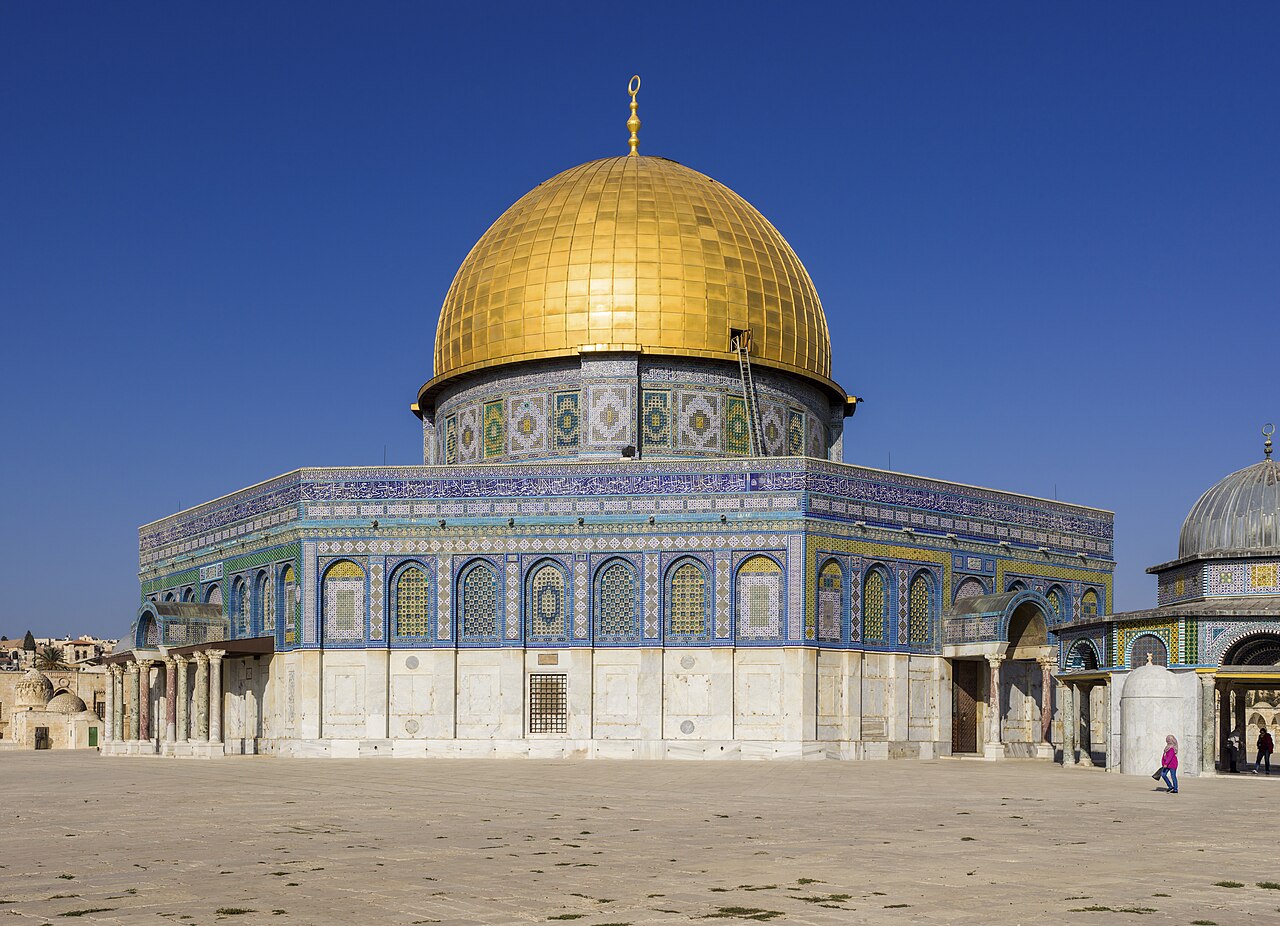
From 1516 to 1917 the Sunni Ottoman Empire ruled the area, and Islam was the religion of the state. Almost all Israeli Muslims are Sunni; no reliable source records a Shia community. The largest Muslim towns include Rahat in the Negev, a Bedouin city of about 78,000 people (2024) and the largest Arab city in Israel, and Umm al-Fahm above Wadi Ara, with about 60,000. On the coast, the old city of Acre keeps the el-Jazzar Mosque, ordered by the Ottoman governor Ahmad Pasha el-Jazzar in 1781.
Two smaller Muslim groups stand out. The Ahmadiyya community arrived in 1928, during the British Mandate; its converts later settled in Kababir on Mount Carmel, now part of Haifa, where about 2,200 Ahmadis live around the Mahmood Mosque, and Kababir serves as the movement's Middle Eastern headquarters. The Circassians, about 4,000–5,000 Sunni Muslims from the North Caucasus whose ancestors the Ottomans settled in Galilee in the 1870s, live mainly in Kfar Kama and Rehaniya. Muslim marriage, divorce and inheritance are decided by sharia courts.
Christianity, 1.9%: the churches of Jerusalem and Nazareth
At the end of 2022 Israel had about 185,000 Christians, and 75.8% of them were Arabs, most living in Haifa, Nazareth, Shefa-Amr and Galilee villages such as Jish, Mi'ilya and Fassuta. Ten churches are recognised for personal status: the Latin, Armenian Catholic, Chaldean Catholic, Melkite Greek Catholic, Syriac Catholic and Maronite churches, plus the Greek Orthodox, Syriac Orthodox, Armenian Apostolic and Episcopal churches. The Melkite Greek Catholic Church is the largest, with about 40% of all Christians in Israel, ahead of the Greek Orthodox Patriarchate of Jerusalem with about 30% and the Latin Patriarchate with 13%.
The holiest church is the Church of the Holy Sepulchre in the Christian Quarter of Jerusalem's Old City. In about 326 Emperor Constantine ordered a church built here over the site tradition holds to be Golgotha and the tomb of Jesus. The Fatimid caliph al-Hakim destroyed it in 1009, and it was rebuilt by 1048. Today it is the seat of the Greek Orthodox, Armenian and Latin patriarchates, while the Coptic, Syriac and Ethiopian churches hold smaller parts. In Nazareth, the Catholic Basilica of the Annunciation, designed by the Italian architect Giovanni Muzio and built by the Israeli firm Solel Boneh between 1960 and 1969, stands over the site Catholic tradition gives as the house of Mary; a Greek Orthodox Church of the Annunciation marks a rival site at the town's spring.
Not every Christian in Israel is Arab. Some are immigrants from the former Soviet Union who arrived with Jewish relatives, and an estimated 20,000 people follow Messianic Judaism, which accepts Jesus as the Messiah but keeps Jewish festivals.
The Druze, 1.6%: Galilee, Mount Carmel and Nabi Shu'ayb
Israel had about 150,000 Druze at the end of 2022, ten times the number in 1948 and the third-largest Druze population in the world after Syria and Lebanon. The faith began in 11th-century Fatimid Egypt, branching from Ismaili Shia Islam, and gives a central role to the sixth Fatimid caliph, al-Hakim bi-Amr Allah. Its followers do not consider themselves Muslims, do not accept the Five Pillars of Islam and do not accept converts. Druze villages sit in Galilee and on Mount Carmel, and further Druze communities live in the Golan Heights, which Israel captured from Syria in 1967 and later annexed; the United States and Colombia recognise that annexation, while most countries regard the Golan as occupied Syrian territory.
At the request of its leaders, Israel designated the Druze a distinct community in 1957, and Druze men have been conscripted into the army since 1956, with enlistment rates above 80%. The community's spiritual leadership comes from the Tarif family; Sheikh Amin Tarif led it until his death in 1993. The faith's most important shrine is Nabi Shu'ayb, west of Tiberias near the ruins of Hittin, which holds the tomb Druze identify with Jethro, the father-in-law of Moses. Pilgrimages there are recorded from the 12th century, the present building dates from 1880, and the community gathers there every April.
Baháʼís and Samaritans: Haifa, Acre and Mount Gerizim
The Baháʼí Faith has its world centre in Israel because the Ottoman Empire sent its founder, Baháʼu'lláh, as a prisoner to Acre, where he spent his last years. His shrine stands at Bahjí outside Acre, and the gold-domed Shrine of the Báb, framed by garden terraces, climbs the north slope of Mount Carmel in Haifa. In July 2008 UNESCO inscribed these holy places on the World Heritage List, the first sites of a relatively new religion to be recognised. A 1987 agreement signed by Shimon Peres, then foreign minister, confirmed the faith as a recognised community. The Baháʼís in Israel are mostly about 600–700 unpaid foreign volunteers, and the faith does not seek or accept converts inside the country.

The Samaritans are one of the world's smallest religious communities: 712 people in 2007 and about 900 by 2024. They follow an Israelite religion close to Judaism but recognise only their own version of the Torah and hold that Mount Gerizim, not the Temple Mount, is God's chosen sanctuary. Almost all of them live either in Kiryat Luza on Mount Gerizim near Nablus in the West Bank or in the Neve Pinchas quarter of Holon, near Tel Aviv. The Chief Rabbinate classifies them as Jews for citizenship purposes, although the census counts them separately.
Marriage, religious courts and the Chief Rabbinate's monopoly
The 14-community system is a legacy of the Ottoman millet arrangement, which the British Mandate left in place and Israel kept. Marriages can be performed in Israel only within a recognised community, so there is no civil marriage apart from a narrow 2010 civil-union law for couples registered as having no religion, and couples of different religions or of the same sex cannot marry inside the country. The state does register civil, interfaith and same-sex marriages performed abroad, which is why many Israelis marry in nearby Cyprus or, since 2022, through online ceremonies officiated from Utah, which the Supreme Court effectively accepted on 7 March 2023.
The Pew Research Center places Israel among the countries with "high restrictions" on religion, partly because of limits on non-Orthodox Judaism. Yet the population itself is far from uniformly devout: in a 2015 Gallup survey, 65% of Israelis said they were either not religious or convinced atheists, and 30% called themselves religious. Religion also maps closely onto language, since Hebrew and Arabic speakers largely belong to different communities, a pattern explored in our guide to the languages spoken in Israel. For the headcounts behind each group, see the population of Israel; for the walled city at the heart of three faiths, read about Jerusalem's Old City.