
The main types of volcanoes are fissure vents (including flood basalts), shield volcanoes, cinder cones, stratovolcanoes (also called composite volcanoes), lava domes and calderas. Which one forms depends mostly on the magma: runny, low-silica basalt spreads into flat fields and broad shields, while thick, silica-rich, gassy magma piles up into steep cones and domes or blows itself apart and leaves a caldera.

The types make more sense as a sequence than as a list to memorise. This guide orders them from runniest magma to stickiest, then covers calderas, which can form at either end.
Silica, temperature and gas: what sets a volcano's shape
Magma is molten rock made mostly of silica (SiO2). Silica molecules link up into chains and networks, so the more silica a melt contains, the stiffer it is. Geologists name the main magma types by their silica content:
- Basalt, about 45–52% silica, erupts at roughly 1,100–1,200 °C. It is hot and fluid.
- Andesite, about 52–63%, is typical of subduction zones; it is named after the Andes.
- Dacite, about 63–68%, was the magma of Mount St. Helens in 1980.
- Rhyolite, over about 68%, erupts at only around 700–850 °C and can be many millions of times more viscous than basalt.
The second dial is gas. Magma holds dissolved water vapour, carbon dioxide and sulphur dioxide, and as it rises and the pressure falls, the gas comes out of solution like the fizz in an opened bottle. Runny basalt lets bubbles escape; stiff rhyolite traps them until the pressure tears the magma into ash. Viscosity and gas together decide whether lava flows away, piles up, or explodes, and that decides the shape. Plate setting controls which magma reaches the surface (see how volcanoes form).
Fissure vents and flood basalts: no mountain at all
At the runny extreme, basalt can erupt from a long crack instead of a single pipe, and it travels so far that no mountain builds up at all. This is a fissure eruption, and it can be one of the most destructive kinds.
The clearest historical case is Laki (Lakagígar) in southern Iceland. Between 8 June 1783 and February 1784, a fissure about 27 km long opened in stages, with around 140 vents along it. Over eight months it poured out roughly 14 km³ of basalt lava, among the largest lava outpourings in recorded history. Its sulphur dioxide and fluorine poisoned the grass and killed most of Iceland's grazing animals. The famine that followed killed an estimated fifth of the island's people (published estimates range from about a sixth to a quarter), and a sulphurous haze spread across Europe that summer.
Repeat that process for hundreds of thousands of years and you get a flood basalt province, also called a large igneous province or "traps". India's Deccan Traps erupted around 66 million years ago and still cover roughly 500,000 km² of the Deccan Plateau. The Siberian Traps, about 252 million years old, are linked to the end-Permian mass extinction. Neither looks like a volcano; both are stepped plateaus of stacked lava sheets.
Shield volcanoes: Mauna Loa and Hawaii's low giants
When runny basalt comes out of one central area again and again, it builds a shield volcano. The lava travels tens of kilometres before it freezes, so the volcano grows wider far faster than it grows taller. The result is a broad dome with flanks mostly under 10 degrees, which early observers likened to a warrior's shield lying face up.

Mauna Loa is the reference example. Its summit reaches 4,169 m above sea level, but it rises about 9 km from the surrounding sea floor, and its weight has pressed the oceanic crust down by several kilometres more. Published estimates of its volume run from about 65,000 to 80,000 km³ (75,000 km³ is the figure usually quoted), and it covers roughly half of the Island of Hawaiʻi. Its most recent eruption ran from 27 November to 10 December 2022.
Shields are low, but they are not small. The tallest volcano in the solar system, Olympus Mons on Mars, is a shield, and the highest volcanoes in the world measured from base to summit are Hawaiian shields, not Andean cones.
Cinder cones: Parícutin, the volcano that started in a cornfield
Basalt does not always flow quietly. When it is rich in gas, the escaping bubbles throw lava up in fountains, and the clots cool in the air and fall as cinders (scoria) and lava bombs. They pile up around the vent at their angle of repose, about 30–35 degrees, building a steep cone with a bowl-shaped crater on top. Cinder cones are the smallest common type. Most rise less than about 300 m above their surroundings, and most erupt only once.
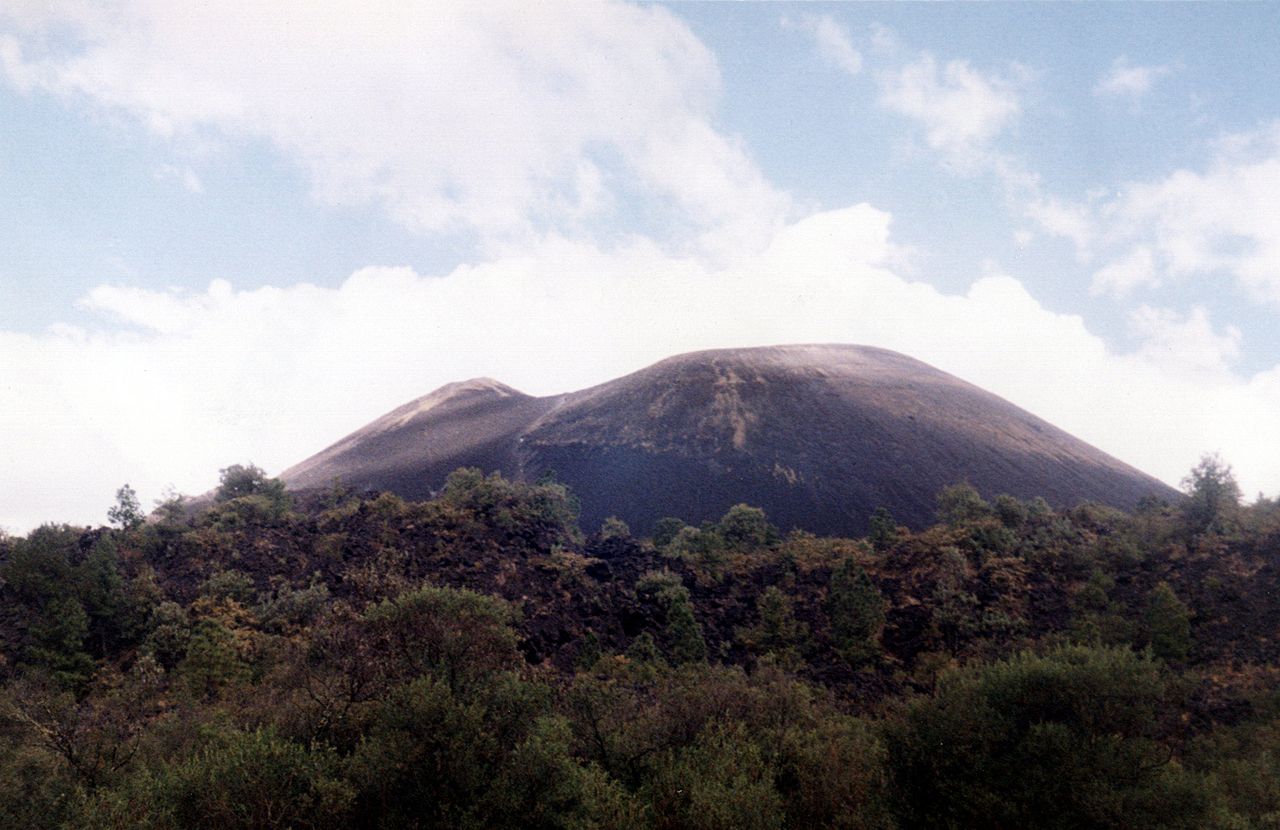
Parícutin in the Mexican state of Michoacán is one of the very few volcanoes scientists have watched from birth to extinction. On 20 February 1943 a crack opened in the cornfield of a farmer, Dionisio Pulido, and began to hiss and throw out stones. Within a year the cone stood 336 m high. The eruption ended in 1952, leaving a cone 424 m above the former field. Lava from vents at its base covered about 25 km² and buried the villages of Parícutin and San Juan Parangaricutiro. Nine years is long for a cinder cone, and Parícutin is just one of more than 1,000 cones in the Michoacán–Guanajuato volcanic field.
Stratovolcanoes and lava domes: when magma is too stiff to flow
Stratovolcanoes (composite volcanoes)
Andesite and dacite cannot run far, so their lava stops near the vent. Between lava flows these volcanoes also erupt explosively, dropping layers of ash and pumice. The alternating layers give the stratovolcano (or composite volcano) both its names. The lava layers hold the ash in place, so upper slopes can reach 30 degrees or more. Most sit above subduction zones around the Pacific Ring of Fire.
Japan's Mount Fuji, 3,776 m high, is the textbook silhouette. It last erupted in December 1707 (the Hōei eruption). It complicates the silica rule: Fuji is mostly basalt, steepened by frequent explosive eruptions. Mount St. Helens in Washington is more typical. On 18 May 1980 its dacite magma caused a landslide and lateral blast that lowered the summit from 2,950 m to 2,549 m and killed 57 people.
Lava domes

When dacite or rhyolite has lost most of its gas, it no longer explodes. It squeezes out like toothpaste and heaps up over the vent as a lava dome. Mount St. Helens built one dome in 1980–86 and a second from October 2004 to January 2008, which reached about 93 million m³.
Domes are dangerous because their steep flanks collapse. A collapsing hot dome sends out a pyroclastic flow, an avalanche of gas and rock that can travel at over 100 km/h. On 8 May 1902 a pyroclastic flow from the dome of Mont Pelée on Martinique destroyed the town of Saint-Pierre and killed about 28,000 people. At Unzen in Japan, a dome collapse on 3 June 1991 killed 43 people, among them the volcanologists Katia and Maurice Krafft and Harry Glicken. Some domes stand alone, like California's Lassen Peak.
Calderas: volcanoes that collapse inward
A caldera is a basin left when an eruption empties the magma chamber so fast that the ground above falls in. It is defined by collapse, not magma type (more in what is a caldera).
The largest calderas come from rhyolite eruptions. Lake Toba in Sumatra fills a caldera about 100 km long and 30 km wide, left by an eruption around 74,000 years ago that discharged at least 2,800 km³ of magma (some newer studies estimate 3,800 km³). Yellowstone has had three caldera-forming eruptions, the latest 631,000 years ago. Oregon's Crater Lake fills the caldera left when Mount Mazama, a stratovolcano, erupted about 50 km³ of magma roughly 7,700 years ago and collapsed. At 594 m it is the deepest lake in the United States.
Shields form calderas too, by quieter collapse. In 2018, as magma drained from beneath Kīlauea's summit to erupt in its Lower East Rift Zone, parts of the caldera floor dropped by around 500 m.
Shield vs stratovolcano: why shape is not the same as eruption size
Shields and stratovolcanoes differ on almost every measure:
- Magma: shields erupt basalt; stratovolcanoes mostly erupt andesite and dacite.
- Slopes: shields mostly under 10 degrees; strato cones often 30 degrees or more near the top.
- Setting: shields grow over hotspots and rifts (Hawaii, Iceland, Galápagos); stratovolcanoes grow above subduction zones (Japan, the Andes, the Cascades, Indonesia).
- Hazard: shields mainly produce lava flows that destroy property but can usually be outrun; stratovolcanoes produce ash, pyroclastic flows and lahars that kill people far from the summit.
Shape and eruption size are not the same thing, though. Eruption size is measured on the Volcanic Explosivity Index (VEI), which runs from 0 to 8. Each step from VEI 2 upward means about ten times more ejected material, and VEI 8 means at least 1,000 km³. Mauna Loa's 2022 eruption rated VEI 0: much lava, almost no explosion. St. Helens in 1980 was VEI 5, Pinatubo in 1991 VEI 6, Tambora in 1815 VEI 7 and Toba VEI 8. Laki shows why the scale is not a damage ranking. Its fissure produced little ash and scores only VEI 4, yet it caused one of the worst disasters of the eighteenth century. Shape tells you the magma; it does not tell you the size of the next eruption.
One volcano can pass through two of these types: the geography of Crater Lake traces Mazama from stratovolcano to caldera.