
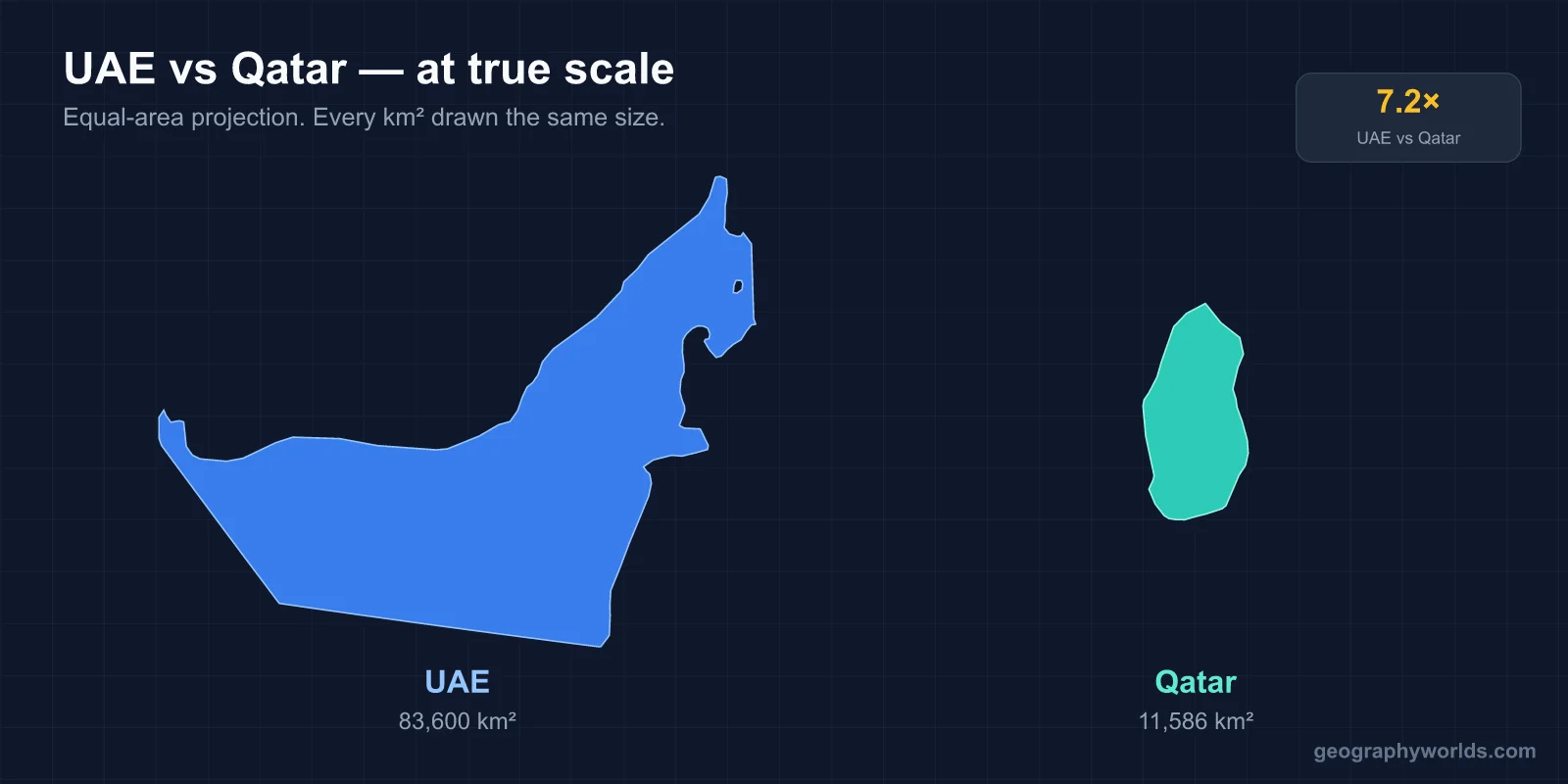
The United Arab Emirates is about seven times larger than Qatar (83,600 square kilometres against 11,586) and has roughly three and a half times as many people (about 11.3 million against 3.2 million), but Qatar is richer per person because it sits on the world's largest single gas field. The UAE is a seven-emirate federation whose economy is now three-quarters non-oil; Qatar is a single-city peninsula state that lives on liquefied natural gas. Both have left OPEC: Qatar in 2019, the UAE on 1 May 2026.
A Federation of Seven and a Peninsula of One
The two countries were nearly the same country. When Britain announced in 1968 that it would withdraw from the Gulf, nine sheikhdoms under British protection opened talks on a single federation: the seven Trucial States, Bahrain and Qatar. Bahrain and Qatar dropped out over questions of representation and capital, and Qatar declared independence on 3 September 1971. The United Arab Emirates was proclaimed on 2 December 1971 by six emirates, with Ras al-Khaimah joining as the seventh on 10 February 1972.
That history still shapes the map. The UAE is a federation in which Abu Dhabi holds about 87 per cent of the land and most of the oil, Dubai is the commercial engine, and Sharjah, Ajman, Umm al-Quwain, Ras al-Khaimah and Fujairah keep their own rulers, courts and development plans. The president has always been the ruler of Abu Dhabi; Sheikh Mohamed bin Zayed has held the post since 2022. Qatar is a unitary emirate ruled by the Al Thani family, with Emir Tamim bin Hamad in power since 2013, and nearly everything happens in and around one city, Doha.
- Capitals: Abu Dhabi (UAE) and Doha (Qatar).
- Largest city: Dubai, with about 4 million residents, is bigger than all of Qatar.
- Currency: UAE dirham and Qatari riyal, both pegged to the US dollar (3.6725 dirhams and 3.64 riyals).
- Official language: Arabic in both, with English the everyday working language of business.
Land, Coast and the Border That Disappeared
Qatar is a limestone thumb about 160 kilometres long and 80 wide, poking north into the Persian Gulf. Its only land border, roughly 87 kilometres long, is with Saudi Arabia at the base of the peninsula, and its highest point, Qurayn Abu al Bawl, is barely 103 metres above sea level. The coastline runs to about 563 kilometres. The UAE, by contrast, wraps around the southern Gulf coast for some 1,300 kilometres, reaches the Gulf of Oman at Fujairah and Khor Fakkan, and borders both Saudi Arabia and Oman. In the north-east the Hajar Mountains rise to about 1,900 metres on the slopes of Jebel Jais in Ras al-Khaimah, a landscape Qatar has nothing like.
The two states once touched. The tidal inlet of Khor al Udeid, at Qatar's south-eastern corner, was claimed by Abu Dhabi for much of the 20th century. The 1974 Treaty of Jeddah between the UAE and Saudi Arabia handed Saudi Arabia a corridor of coast there, so today a strip of Saudi territory separates Qatar from the UAE and the two meet only at sea. A drive from Doha to Abu Dhabi has to cross Saudi territory, entering at Salwa and leaving again at Al Ghuwaifat. The site's guide to the countries that border Qatar covers that frontier in more detail.

Both climates are hot desert. Summer highs pass 45 degrees Celsius in July and August, and rainfall averages well under 100 millimetres a year. Qatar's surrounding shallow sea makes its summers especially humid, while the UAE's interior includes the edge of the Rub' al Khali, the Empty Quarter, around the Liwa Oasis, and its mountains are a few degrees cooler.
Eleven Million and Three Million, Mostly From Elsewhere
The UAE's Federal Competitiveness and Statistics Centre put the population at about 11.3 million at the end of 2024, up from 10.7 million a year earlier. Qatar's National Planning Council counted about 3.21 million residents in December 2025, a 2.3 per cent rise on the year. In both countries citizens are a small minority, commonly estimated at around a tenth of residents; neither government publishes a regular breakdown. Most residents are workers from India, Pakistan, Bangladesh, Nepal, the Philippines, Egypt and elsewhere, which also tilts both populations heavily male: about 64 per cent of UAE residents are men, and in Qatar men outnumber women by about three to one.
Because Qatar packs its people onto a much smaller area, it is about twice as dense, close to 280 people per square kilometre against roughly 135 in the UAE.
Gas From One Field Against an Economy of Everything
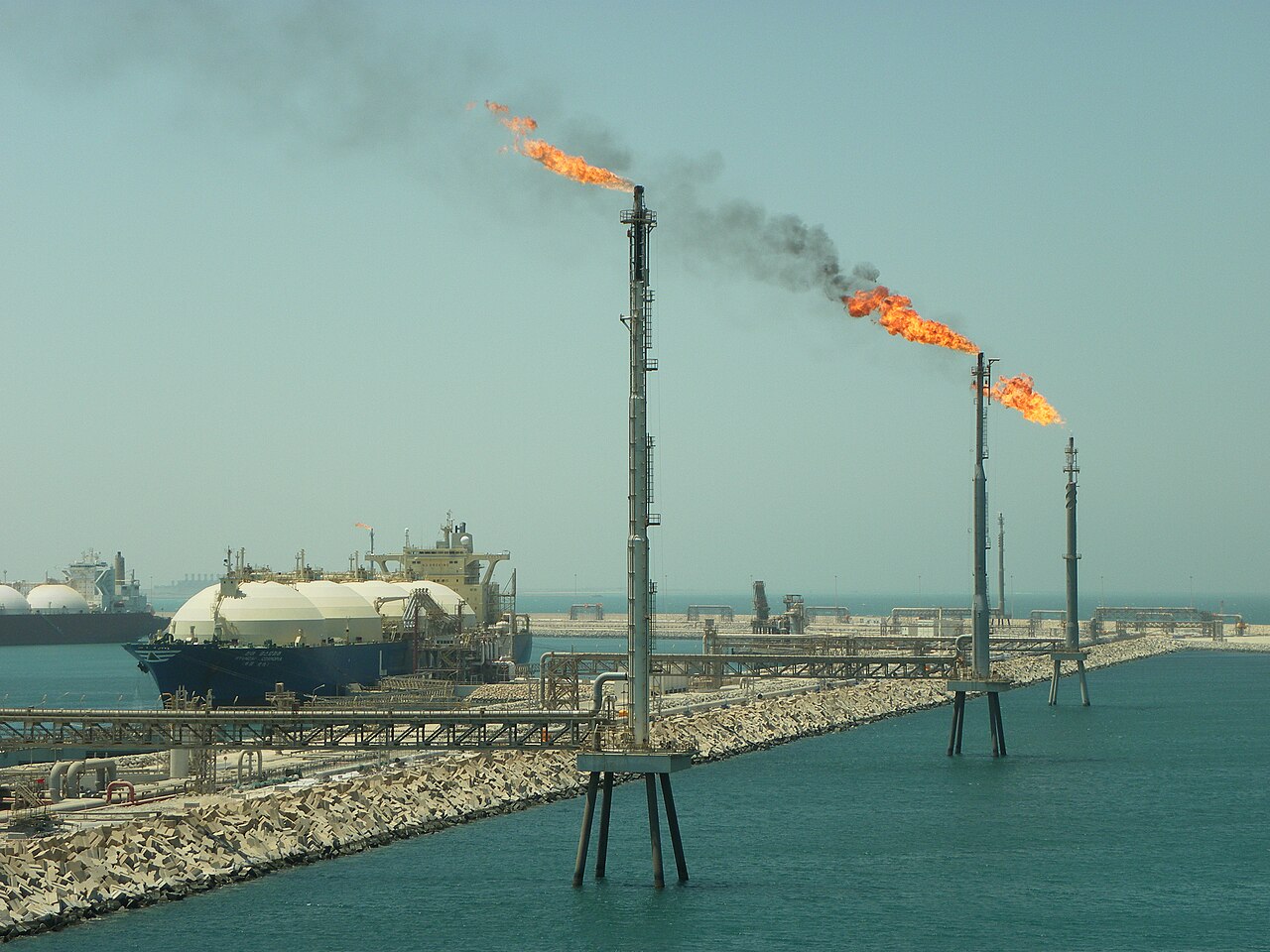
Qatar's wealth comes from the North Field, which it shares with Iran (where it is called South Pars) beneath the Gulf. It is the largest natural gas field in the world. Gas is piped ashore to Ras Laffan Industrial City, about 80 kilometres north of Doha, where it is chilled to minus 162 degrees Celsius and loaded onto tankers. QatarEnergy's capacity was about 77 million tonnes of LNG a year in 2024, and the North Field East, South and West expansions aim to lift that to 142 million tonnes by the end of 2030. Qatar is usually the world's second or third largest LNG exporter, alongside the United States and Australia, and hydrocarbons still supply the large majority of government revenue.
The UAE has more oil than Qatar, with ADNOC working towards 5 million barrels a day of production capacity by 2027, but oil is no longer the bulk of the economy. Federal statistics put non-oil activity at 75.5 per cent of real GDP in 2024, led by trade, manufacturing, and finance and insurance. Dubai built that model on Jebel Ali, the largest port in the Middle East; on Emirates airline and Dubai International, the world's busiest airport for international passengers; and on free zones, tourism and property. Abu Dhabi added sovereign wealth, aluminium and the four-reactor Barakah nuclear plant, which now supplies about a quarter of the country's electricity.
The headline numbers reflect the difference. IMF estimates for 2025 put the UAE's nominal GDP at roughly 570 to 600 billion US dollars and Qatar's at roughly 220 to 240 billion, but Qatar's output per person, at around 71,000 to 75,000 dollars, is well above the UAE's 51,000 or so.
Two Exits From OPEC, Seven Years Apart
Qatar joined OPEC in 1961 and left on 1 January 2019, saying it wanted to concentrate on gas, where OPEC has no say. Its oil output, around 600,000 barrels a day of crude, made it one of the cartel's smallest producers, though the timing, 18 months into its dispute with Saudi Arabia, was widely read as political as well.
The UAE's departure was a bigger shock. Abu Dhabi had been a member since 1967, before the federation existed. On 28 April 2026 the UAE announced it would leave both OPEC and the wider OPEC+ alliance, and the exit took effect on 1 May, ending 59 years of membership and leaving OPEC with 11 members. The UAE cited its national interest; for years it had pushed for a production quota closer to its expanded capacity. The current list of OPEC members shows who remains after both exits.
The 2017 Blockade and the Al-Ula Reconciliation
The sharpest break between the two came on 5 June 2017, when Saudi Arabia, the UAE, Bahrain and Egypt cut diplomatic ties with Qatar, closed their airspace to Qatari aircraft, and Saudi Arabia shut the Abu Samra crossing, Qatar's only land border. The quartet accused Doha of supporting extremist groups and of being too close to Iran, and issued 13 demands, among them closing the Al Jazeera network and a Turkish military base. Qatar rejected them.
The blockade forced Qatar to adapt quickly. Turkey and Iran sent food, Qatar flew in thousands of dairy cows and built the Baladna farm to become self-sufficient in milk, and Hamad Port, which had opened at the end of 2016, took shipping that used to come through Jebel Ali. Qatar Airways rerouted over Iranian airspace. Throughout, Qatari gas kept flowing to the UAE through the Dolphin pipeline, which has supplied Abu Dhabi and Dubai since 2007 and was never shut off, a reminder of how intertwined the two economies were.
The dispute ended at the Gulf Cooperation Council summit in the Saudi town of AlUla on 5 January 2021, where the leaders signed the Al-Ula Declaration and Saudi Arabia reopened its border the evening before. The UAE and Qatar restored relations more slowly than the Saudis did, but ambassadors returned in 2023 and flights, trade and visits have since resumed.
Bahrain and Kuwait: The Other Small Gulf Monarchies
Set beside their neighbours, the UAE and Qatar look less unusual. Bahrain, at about 780 square kilometres, is far smaller than either and has the least oil left in the GCC, so it moved early into banking and is now tied closely to Saudi Arabia by the King Fahd Causeway. Kuwait, at about 17,800 square kilometres, is larger than Qatar and has a similar population of around 5 million, but unlike both it remains in OPEC, relies on crude for most of its revenue and has an elected parliament with real powers, which the UAE and Qatar lack. All four sit on the shallow, salty waters of the Persian Gulf.
The rivalry between Abu Dhabi and Doha now plays out in softer arenas: airlines, sovereign wealth funds, mediation in regional wars, the 2020 Dubai Expo against the 2022 FIFA World Cup, and the Louvre Abu Dhabi against Qatar's Museum of Islamic Art. If you want to see how much of that story fits on a single peninsula, the guide to Doha as Qatar's capital walks through the city that holds most of the country.