
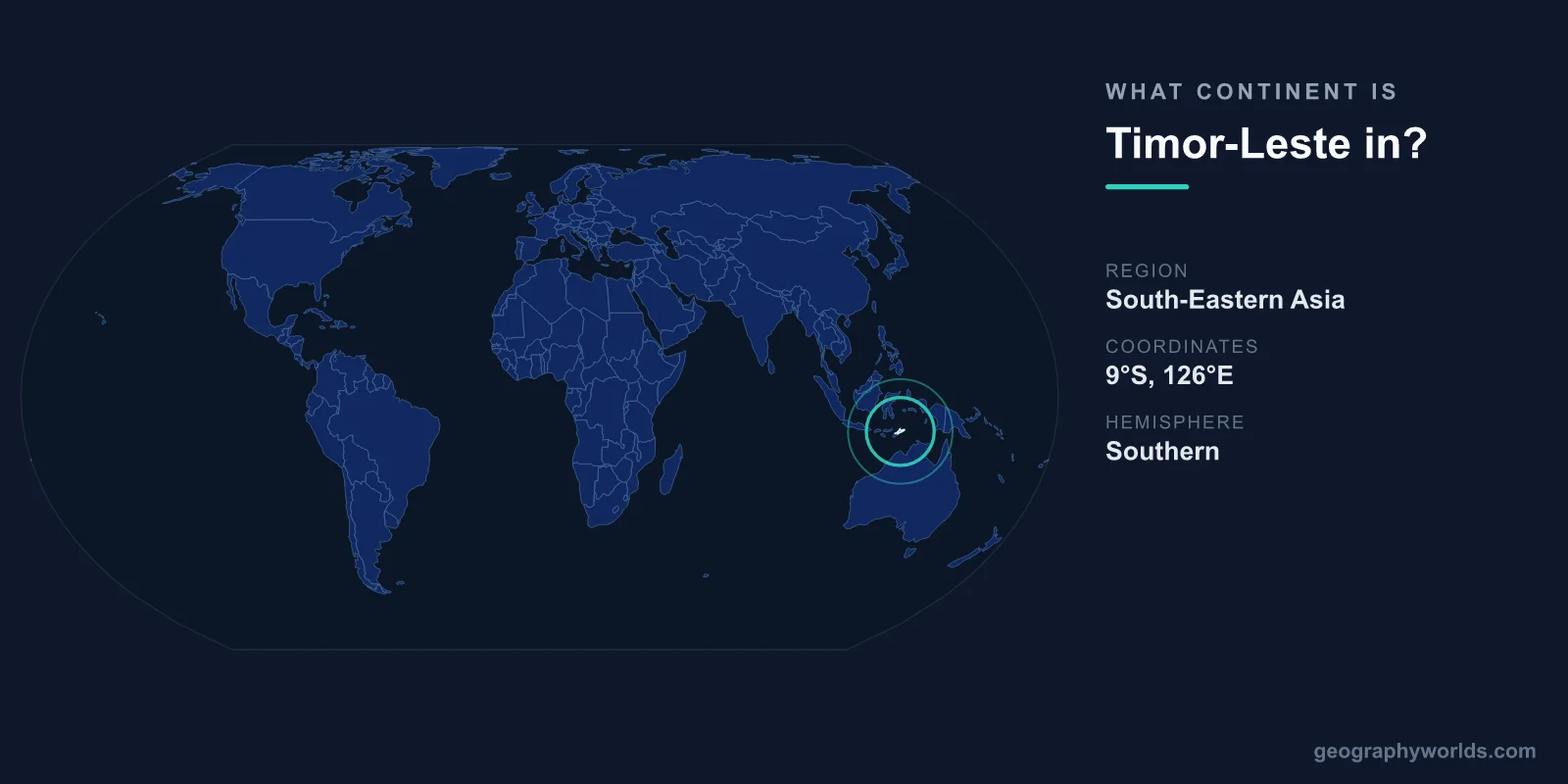
Timor-Leste (East Timor) is in Asia. It belongs to Southeast Asia, occupying the eastern half of the island of Timor at the southern edge of the Malay Archipelago, plus the Oecusse exclave and the islands of Atauro and Jaco, about 15,000 km² in all. The United Nations lists it in South-eastern Asia, and on 26 October 2025 it became the 11th member of ASEAN. The answer feels less obvious than it should because the island itself is built largely from rock of the Australian continental margin, Australia lies less than 500 km away across the Timor Sea, and the country's wildlife, languages and diplomacy all reach towards Oceania as well.
Southeast Asia on the UN Map, in the Atlas and in Sport
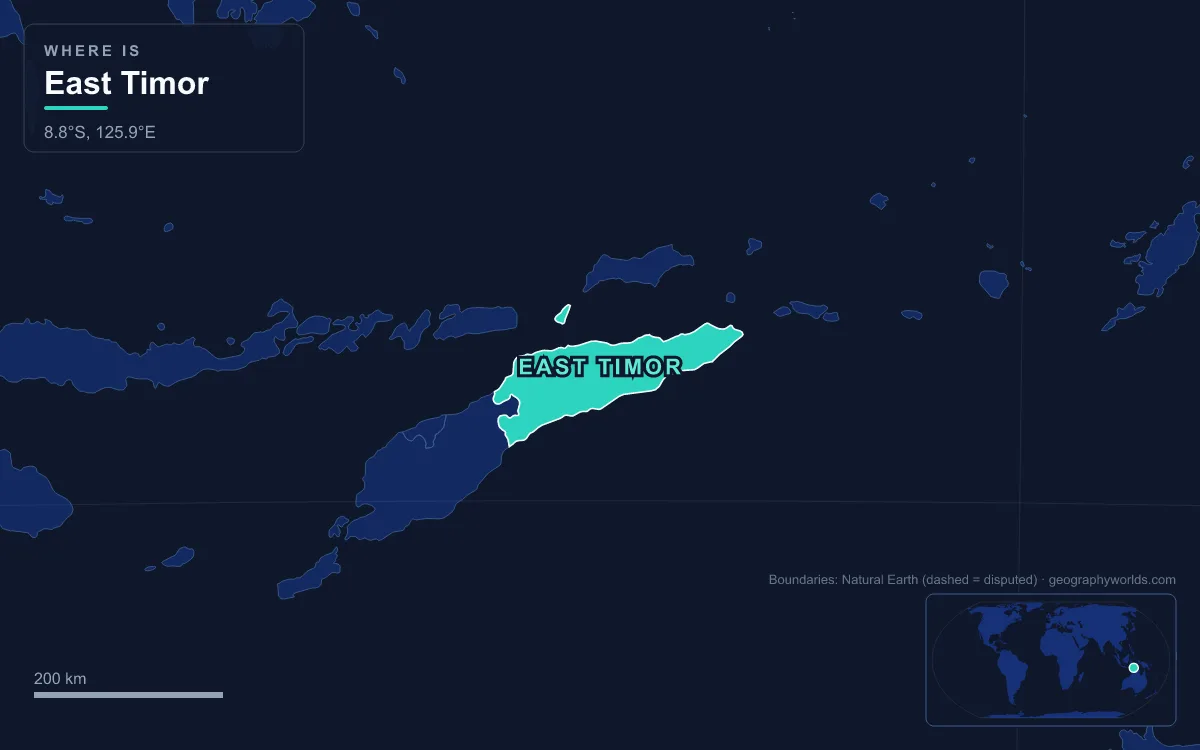
Every standard political classification puts Timor-Leste in Asia. The United Nations statistical geoscheme places it in South-eastern Asia alongside Indonesia, the Philippines and Malaysia, and common definitions of Oceania leave it out, along with Brunei and Indonesian New Guinea. Geographers place the island of Timor among the Lesser Sunda Islands, the chain that runs east from Bali through Lombok, Sumbawa and Flores, and Timor is the largest of them at 30,777 km².
The country's sporting life follows the same map. Timor-Leste first competed at the Asian Games in 2002, joined the Southeast Asian Games in Hanoi in 2003, a year after independence, and its national football team, nicknamed the Crocodiles, plays in the Asian Football Confederation and the ASEAN Football Federation. It played its first international matches in qualifying for the 2004 AFC Asian Cup.
The country is about 265 km long and 97 km wide. Its main land border with Indonesian West Timor runs for about 125 km, with roughly another 100 km around Oecusse, which is cut off from the rest of the country by Indonesian territory. To the north lie the Ombai and Wetar straits and the Banda Sea; to the south lies the calmer Timor Sea. The capital, Dili, sits on a narrow coastal plain on the north shore, hemmed in by mountains. On Cape Fatucama, at the end of a peninsula beside the city, stands the 27-metre Cristo Rei statue, unveiled in 1996 by Indonesia's President Suharto as a gift to what was then an Indonesian province, and reached by a 570-step staircase. For coordinates and neighbours in more detail, see where Timor-Leste is.
Timor Island Is Built from the Australian Plate
Geology is the first source of doubt. Most of the islands around Timor are volcanoes, but Timor is not part of that volcanic arc. It is the principal island of the Outer Banda Arc, a ridge being pushed up where the northern edge of the Indo-Australian Plate runs into the Eurasian Plate. As the Australian continent moved north, its thick continental margin was forced under thinner oceanic crust and scraped up into a stack of thrust sheets. The result is that Timor consists mostly of rocks from the Australian continental margin, piled onto Australian continental shelf deposits.
So the ground under Dili belongs to the Australian side of the collision. The active volcanoes are to the north, on Flores, Alor and Wetar, while Timor sits in front of them in what geologists call a forearc position. The mountains this collision raised are among the most mature parts of the Banda range, which runs from Sumba to Seram, and almost half of Timor-Leste has slopes of 40% or more.
The highest of them is Tatamailau, also called Mount Ramelau, at 2,963 m, about 70 km south of Dili in Ainaro municipality. Its Mambai name means "Grandfather of All". During the 20th century, when the territory was still a Portuguese colony, it was counted as the highest mountain of Portugal, since mainland Portugal's peaks are far lower. A three-metre statue of the Virgin Mary was placed on the summit in 1997, and an annual pilgrimage climbs to it around 25 March.

East of the Wallace Line, in Wallacea
The second complication is biological. In 1859 the naturalist Alfred Russel Wallace drew a line through the Lombok Strait, between Bali and Lombok, a gap of only about 35 km, after noticing that the birds and mammals on either side were strikingly different. West of the line, on the Sunda Shelf with Sumatra, Java and Borneo, the animals are Asian: tigers, rhinoceroses, apes. Further east lies the Sahul Shelf, which carries Australia and New Guinea and their marsupials.
Between the two shelves is Wallacea, a group of islands with a combined land area of 347,000 km², separated by deep-water straits that never joined either continent even when sea levels were low. Timor is one of its main islands, together with Sulawesi, Lombok, Sumbawa, Flores and Sumba. Wallacea's eastern boundary is called Lydekker's Line, and the point where Asian and Australian species are roughly balanced is the Weber Line. Timor, together with Wetar, Rote and Savu, forms the Timor and Wetar deciduous forests ecoregion, a dry tropical forest that ecologists place in the Australasian realm. Its wildlife is a genuine mix of Asian and Australian species.
Portuguese Timor, Indonesian Rule and Independence in 2002
History gave Timor-Leste its separate identity from the rest of the island. People have lived at Jerimalai, on its eastern tip, for about 42,000 years, and later Papuan-speaking and Austronesian-speaking settlers created the mix of languages still heard today. By the 14th century Timor was part of Southeast Asian, Chinese and Indian trading networks, exporting sandalwood, honey and wax, and the Majapahit Empire of Java recorded it as a source of tribute.
Sandalwood drew the Portuguese in the early 16th century. Pushed out of other islands by the Dutch, they settled at Lifau in what is now Oecusse, and founded Dili in 1769. The Dutch held the west. A border fixed by the Permanent Court of Arbitration in 1914 still divides Timor-Leste from Indonesia. Even the name reflects the region's languages: Timor comes from the Malay timur, "east", so Timor-Leste literally means "East East".
After Portugal's 1974 revolution, Fretilin declared independence on 28 November 1975. Indonesia invaded on 7 December 1975 and declared the territory its 27th province on 17 July 1976, an annexation that Australia, by 1978, was the only country to recognise officially. The occupation was marked by mass killings and famine: a statistical report for the country's truth commission counted a minimum of 102,800 conflict-related deaths between 1974 and 1999, and other estimates run as high as 200,000. After a UN-run referendum on 30 August 1999 produced a clear vote for independence, militias backed by elements of the Indonesian military carried out a campaign of violence, and an international force, INTERFET, was sent in. On 20 May 2002 Timor-Leste became the first new sovereign state of the 21st century. It chose Portuguese and Tetun as official languages, making it the only sovereign country in Asia where Portuguese is official.

ASEAN's 11th Member Since 26 October 2025
If any single fact settles the continent question politically, it is this one. Timor-Leste set its sights on the Association of Southeast Asian Nations before independence and applied formally in 2011. Indonesia, its former occupier, supported the bid once relations were normalised. Progress was slow, partly because some members doubted that a young, poor state could meet ASEAN's economic and institutional commitments, so Timor-Leste opened embassies in every member state by 2016 to show it was serious.
ASEAN granted observer status and accepted it "in principle" in November 2022. In May 2025 Malaysia's prime minister, Anwar Ibrahim, then ASEAN chair, announced it would be admitted later that year, and on 26 October 2025, at the 47th ASEAN Summit in Kuala Lumpur, Timor-Leste joined as the bloc's 11th member, the first enlargement since Cambodia in 1999. The 2026 summit in the Philippines was the first it attended as a full member. Our guide to ASEAN and the countries of Southeast Asia lists all eleven.
Links Across the Timor Sea to Australia and the Pacific
The pull towards Oceania is real, and it explains why atlases occasionally hesitate. Timor-Leste is an observer at the Pacific Islands Forum and the Melanesian Spearhead Group, and some of its own leaders have promoted closer ties with Melanesian states. Its leaders chose ASEAN over full membership of Pacific bodies, saying that joining them would have blocked the ASEAN bid.
Australia is the southern neighbour and a major partner across the Timor Sea. Oil and gas there have shaped the relationship for decades. After years of dispute over the seabed, the two countries signed a maritime boundary agreement in March 2018, which also settled how revenue from the Greater Sunrise gas fields would be shared: 70 to 80% for Timor-Leste depending on where the gas is piped. Timor-Leste's exclusive economic zone covers about 77,051 km², five times its land area.
Culturally, the Lusophone world matters too: Timor-Leste joined the Community of Portuguese Language Countries in 2002 and hosted its 2014 summit in Dili. None of this changes the continent. The island rides on Australian rock and sits in a transition zone for wildlife, but by political, cultural and statistical convention Timor-Leste is a Southeast Asian country in Asia. Its larger neighbour poses a similar puzzle, which we untangle in whether Indonesia is in Asia or Oceania.