
Yellowstone National Park is a 2.2-million-acre (about 8,990 km²) reserve, mostly in northwest Wyoming with slivers in Montana and Idaho, that was set aside on 1 March 1872 as the world's first national park. It sits on top of an active supervolcano, which powers more than 10,000 hydrothermal features, including roughly half of all the geysers on Earth.
Congress drew the boundary in 1872 before Wyoming, Montana or Idaho were states, which is why the rectangle ignores state lines: about 96% of the park lies in Wyoming, 3% in Montana and 1% in Idaho. Elevations run from 1,610 m near Reese Creek on the northern edge to 3,462 m on Eagle Peak in the Absaroka Range. The easiest way to understand the place is to start underground and then drive the Grand Loop, the 142-mile (229 km) figure-eight road that links almost every major sight.
The Supervolcano Under the Plateau
Yellowstone is a hotspot volcano. A plume of hot mantle rock sits beneath the North American Plate, and as the plate has drifted southwest over it, a chain of older calderas has been left behind across southern Idaho's Snake River Plain. Today the hotspot is under the park, with a crustal magma reservoir a few kilometres down that is mostly solid crystal mush, with only a small share of melt.
Three caldera-forming eruptions have happened here. The Huckleberry Ridge eruption, about 2.1 million years ago, produced roughly 2,450 km³ of material. The Mesa Falls eruption, about 1.3 million years ago, was far smaller at around 280 km³. The Lava Creek eruption, dated to about 631,000 years ago in recent USGS work (older sources round it to 640,000), released about 1,000 km³ and collapsed the present Yellowstone Caldera, roughly 85 by 45 km. Its rim now runs near Canyon Village, Lake Village and Madison Junction, and dozens of lava flows have since filled it. The youngest erupted about 70,000 years ago.
The USGS Yellowstone Volcano Observatory puts the annual chance of another caldera-forming eruption at about 1 in 730,000. The more realistic hazards are hydrothermal explosions, like the one that threw rock and mud over Biscuit Basin's boardwalk in July 2024, and moderate earthquakes. The park records somewhere between 1,500 and 2,500 small quakes in a typical year. The full geology is covered in our guide to the Yellowstone supervolcano.
Upper Geyser Basin: Old Faithful and 150 Geysers in a Square Mile
Rain and snowmelt seep down through cracks in the rhyolite, get heated by the magma system and rise back up through a plumbing of silica-lined channels. Where a channel has a constriction, pressure builds until the column of water flashes to steam and erupts. The Upper Geyser Basin, on the Firehole River in the southwest of the caldera, has about 150 geysers within one square mile, the densest concentration anywhere.
Old Faithful is the best known because it is predictable, not because it is the biggest. Its interval has lengthened over the decades. In January 2025 the NPS reported a median gap of 102 minutes (plus or minus 10), with intervals between 54 and 118 minutes. Rangers predict the next eruption from the length of the last one, and eruptions reach 32 to 55 m, last 1.5 to 5 minutes and throw out 14,000 to 31,800 litres of water. Along the same boardwalks are Castle Geyser, with a sinter cone thought to be thousands of years old; and Grand Geyser, the tallest predictable geyser, at up to about 60 m. Our Old Faithful guide covers prediction times and viewing spots.
Midway and Norris: The Biggest Spring and the Tallest Geyser
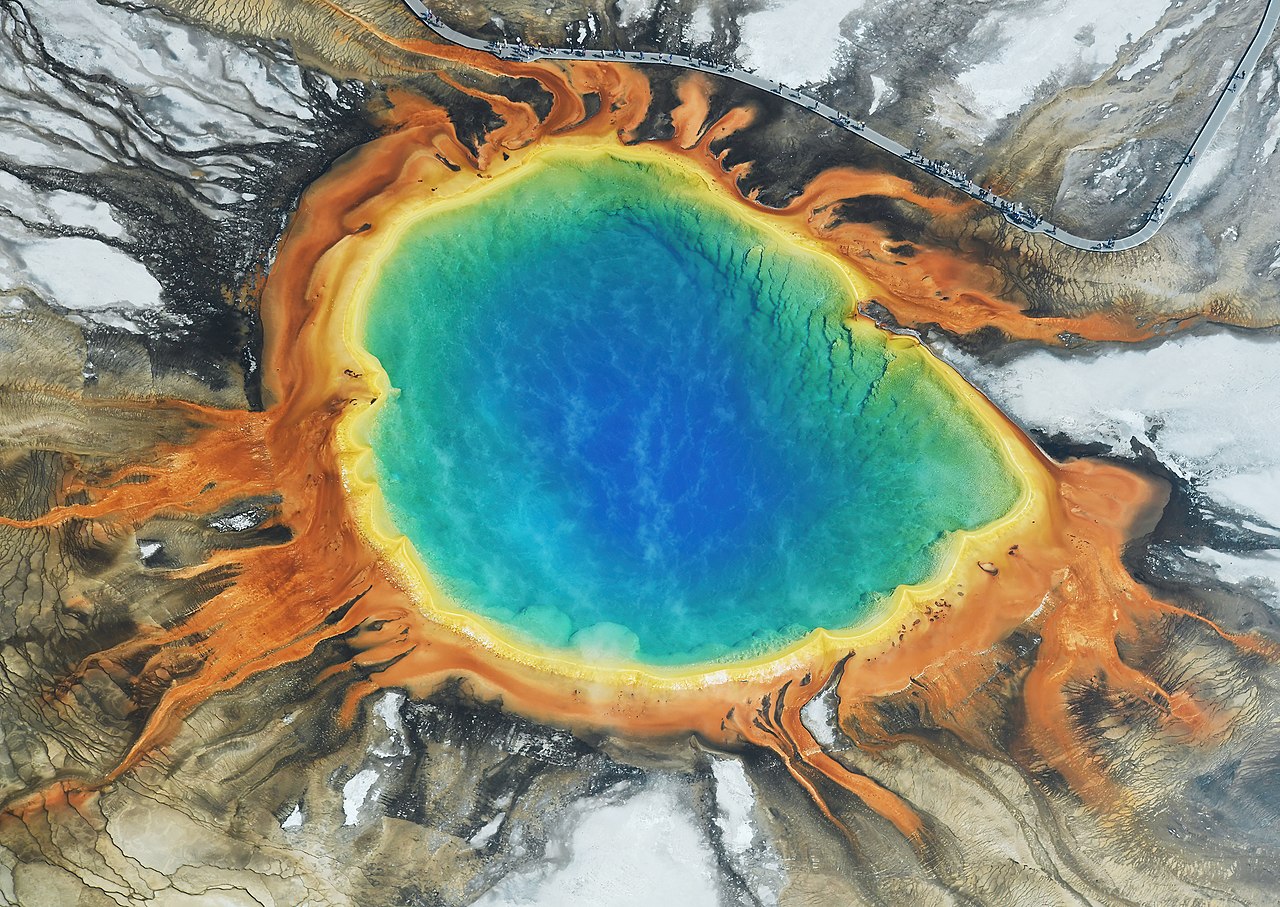
Ten minutes north along the Firehole, Midway Geyser Basin holds Grand Prismatic Spring, the largest hot spring in the United States. The NPS gives its diameter as about 113 m (370 ft) and its depth as more than 37 m. The deep blue centre is too hot for most life, at around 70 °C. Moving outward, the water cools and the rings change colour (green, yellow, orange, brown) as different mats of thermophilic microbes take over at each temperature.
Norris Geyser Basin, at the junction of the caldera rim and two fault zones, is the hottest and most acidic of the major basins. A 1929 research drill hole there measured 237 °C just 332 m down. Norris is home to Steamboat Geyser, the tallest active geyser in the world, with major eruptions that exceed 90 m (300 ft). Steamboat is not predictable. It can go years without a major eruption and then erupt again within days. After waking in March 2018 it put on more than 100 major eruptions over the following five years, a record run that geologists are still trying to explain.
Canyon and Yellowstone Lake: Where the Caldera Rim Shows
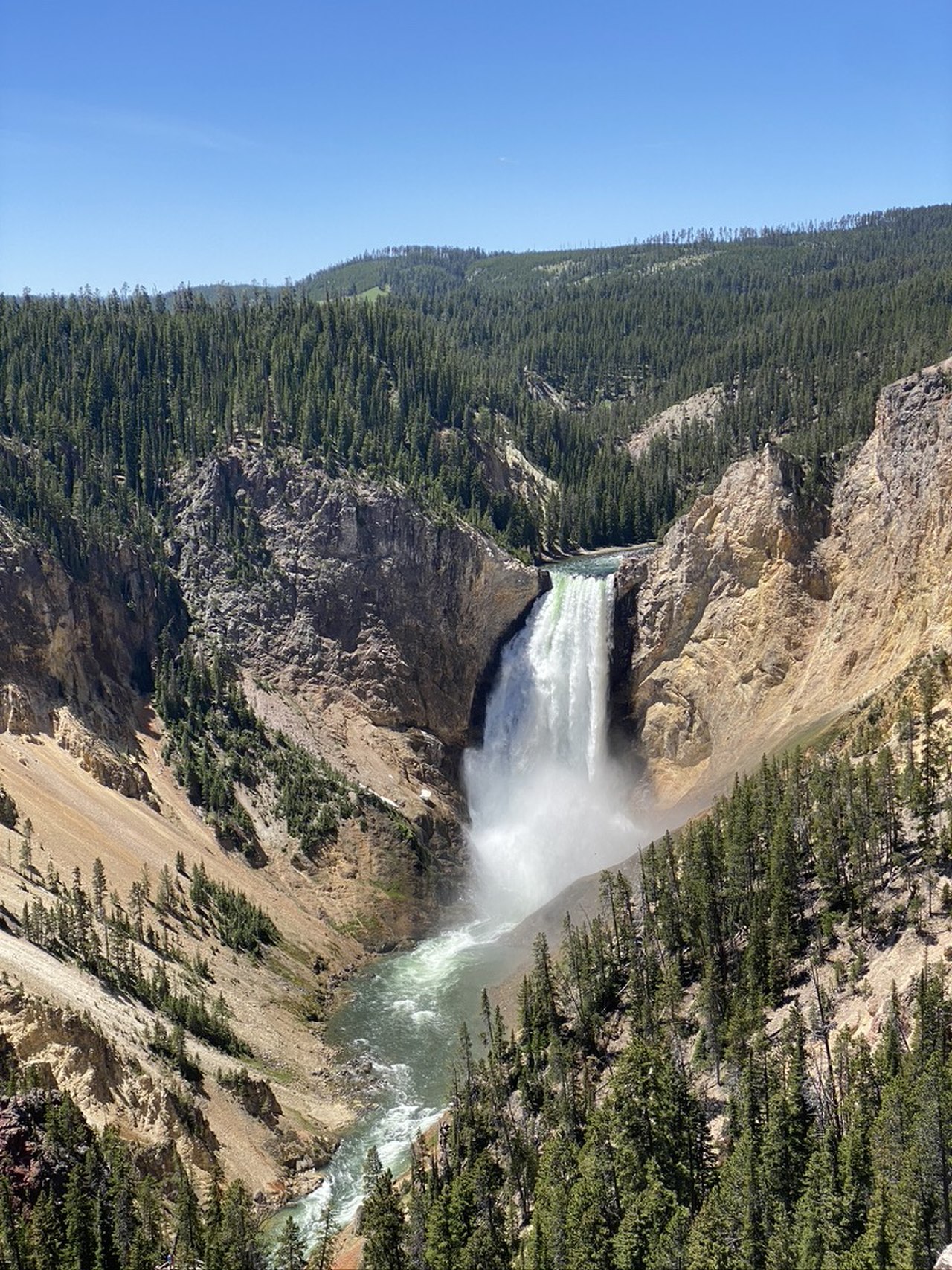
The Yellowstone River leaves Yellowstone Lake heading north and, just past Canyon Village, falls off the edge of a lava flow. The Upper Falls drop 33 m and the Lower Falls 94 m, nearly twice the height of Niagara. Below them the Grand Canyon of the Yellowstone runs for about 32 km and is 240 to 365 m deep. Its walls are rhyolite that hot water rotted and stained into the yellows, pinks and creams in the hero photograph, and the river cut into the softened rock quickly after the last glaciers retreated. Artist Point on the south rim and Lookout Point on the north are the classic views of the Lower Falls.
Yellowstone Lake, which fills part of the caldera, covers about 352 km² at 2,357 m. That makes it the largest freshwater lake above 2,100 m (7,000 ft) in North America. It is about 120 m deep at its deepest, and surveys of the lake floor have found hydrothermal vents, domes and old explosion craters. Mary Bay on the north shore is a crater from a hydrothermal explosion about 13,800 years ago.
Lamar Valley and the Wolves of 1995
Northeast of Tower Junction, the Lamar River runs through a broad glacial valley of sage and grass, nicknamed "America's Serengeti". At dawn you can often see bison herds, elk, pronghorn and grizzlies from the road. Yellowstone's bison have lived wild here without a break since prehistoric times, and recent summer counts put the herd at roughly 5,000 to 6,000. That is the largest bison population on public land in the United States.
Wolves had been killed off in the park by the 1920s. In January 1995, 14 gray wolves captured in Alberta were released from acclimation pens in the Lamar Valley, and 17 more from British Columbia followed in 1996. The population grew quickly, and the NPS counted 108 wolves in nine packs at the end of 2024. That fell to 84 at the end of 2025 after a disease outbreak. Researchers credit the wolves with pushing elk off streamside willow and aspen, although how strong that "trophic cascade" is remains debated.
Mammoth Hot Springs and the Flood of June 2022
At the northern edge of the park, hot water rises through limestone, not rhyolite. It dissolves calcium carbonate on the way up and deposits it at the surface as travertine. The result is Mammoth Hot Springs: a hillside of stepped terraces whose active vents shift from year to year. Next to the terraces stand the stone buildings of Fort Yellowstone, built when the US Army ran the park between 1886 and 1918.

This northern corner took the worst of the June 2022 flood. Heavy rain on a deep, late snowpack sent the Yellowstone, Lamar and Gardner rivers to record levels around 13 June. The USGS gauge at Corwin Springs measured a peak far above the previous record set in 1918. Whole sections of the road between Gardiner and Mammoth and along the Lamar were washed into the rivers, and for the first time since the 1988 fires the park closed to all visitors. The southern loop reopened on 22 June and the northern loop on 2 July. The Northeast Entrance road through the Lamar Valley reopened in mid-October, and the North Entrance at Gardiner reopened on 30 October 2022 via the upgraded Old Gardiner Road. Visits fell to about 3.3 million that year, then recovered: 4,744,353 in 2024 and 4,762,988 in 2025. The 2025 total is the second-highest on record and 2024 the third, both behind 4,860,242 in 2021.
Yellowstone Against the World's Other Geyser Fields
Geysers need three things at once: a strong, steady heat source, plenty of water, and silica-rich rock that can seal the underground channels. That combination is rare, and only a handful of fields have more than a few dozen active geysers. Yellowstone is in a class of its own, with roughly 500 active geysers in most years. The next largest field, Russia's Valley of Geysers in Kamchatka (about 90), was only discovered in 1941 and was partly buried by a landslide in 2007. El Tatio in Chile's Andes has about 80, at 4,300 m. Iceland's Haukadalur valley, home of the Great Geysir that gave every geyser its name, has only a few. Geysir itself is mostly dormant, while neighbouring Strokkur erupts every 5 to 10 minutes to about 15 to 20 m. That is more frequent than Old Faithful, but much smaller.
Compared with Yosemite, its closest rival among American parks for fame, Yellowstone is about three times larger (Yosemite covers some 3,000 km²) and its scenery comes from a different force. Yosemite's granite walls were cut by glaciers, while Yellowstone's landscape was built and is still heated by volcanism. If you are planning a trip, the window between snowmelt road openings and the first autumn closures is short; our month-by-month guide to the best time to visit Yellowstone covers which roads and basins open when.