
Papua New Guinea is the giant of the pair: at 462,840 km² it is 16 times the size of the Solomon Islands (28,896 km²), and its 2024 census counted 10,185,363 people against roughly 721,000 Solomon Islanders in 2019. They are next-door Melanesian neighbours with linked histories, and the island of Bougainville sits in the middle of both stories: geographically it belongs to the Solomon chain, but politically it is part of PNG.
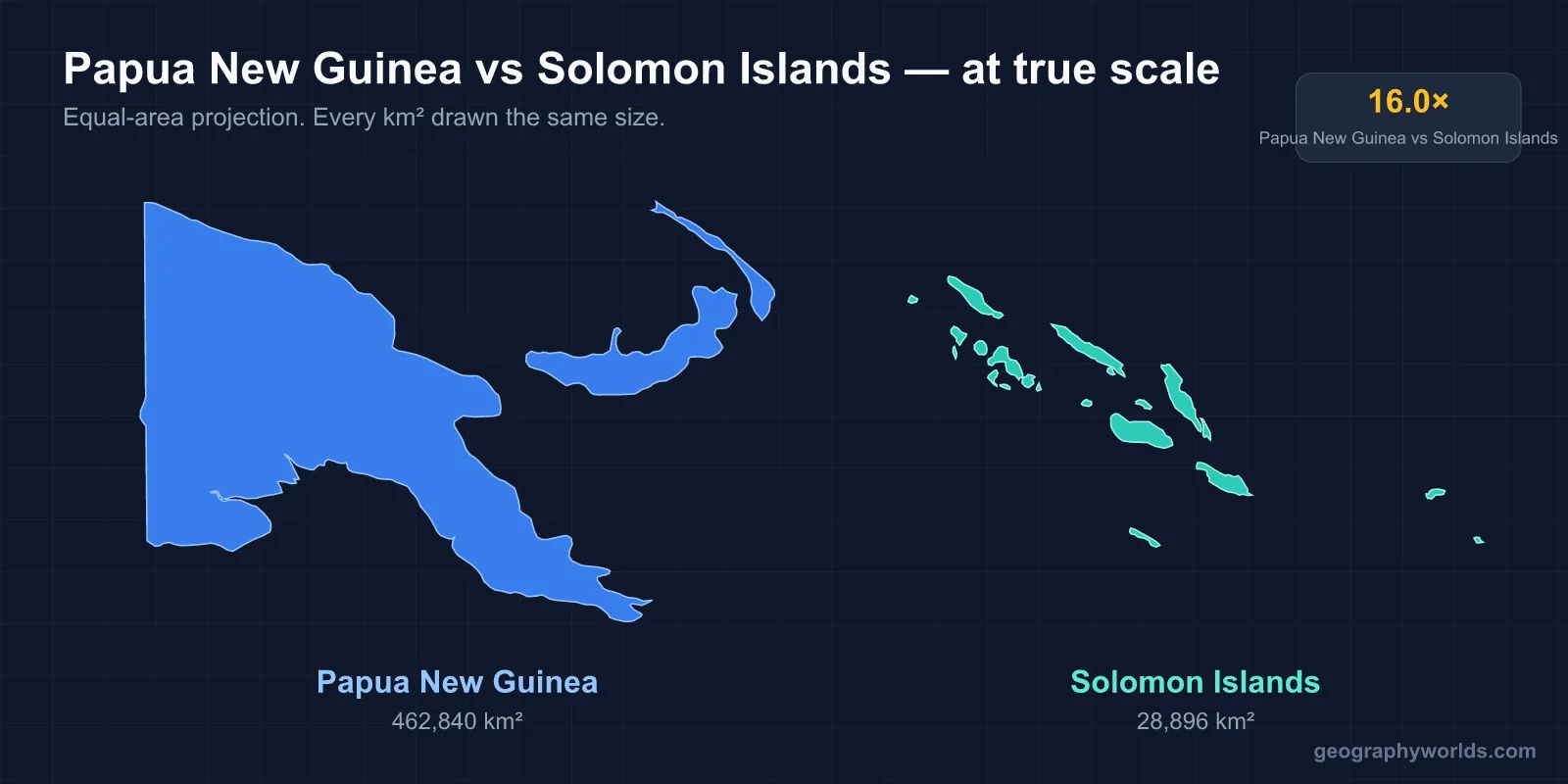
This comparison travels west to east: from the New Guinea mainland, past Bougainville, to Honiara on Guadalcanal.
From the Fly River to Makira: land and people
Papua New Guinea covers the eastern half of New Guinea, the world's second-largest island. Its only land border, about 820 km long, runs almost straight north to south and divides the island from the Indonesian provinces of Papua. The interior is a spine of ranges. Mount Wilhelm reaches 4,509 m. The Sepik and Fly rivers each run for more than 1,000 km. Off the coast lie New Britain, New Ireland, Manus and some 600 smaller islands.
The Solomon Islands is a double chain of six main islands, Choiseul, Santa Isabel, New Georgia, Guadalcanal, Malaita and Makira, plus some 900 smaller islands and atolls stretching about 1,500 km to the Santa Cruz group. Its highest point, Mount Popomanaseu on Guadalcanal, is about 2,335 m. Measured in land, PNG is the far larger country. Measured in sea, the gap is much smaller, because the Solomons' scattered islands give it an exclusive economic zone of around 1.6 million km², not far below PNG's roughly 2.4 million km².
For years nobody knew PNG's population to within several million. In late 2022, a leaked UN-commissioned study that used satellite imagery and household surveys suggested about 17 million people, close to double the government's working figure of around 9.4 million. The UN later revised its own estimate to 11.8 million. The 2024 National Population Census, whose final figures were released in November 2025, settled on 10,185,363, with 5.34 million males and 4.85 million females.
The Solomon Islands counted about 721,000 people on census night, 24 November 2019, an increase of roughly 170,000 since 2009. UN estimates for the mid-2020s put the total above 800,000. Honiara had 129,569 residents in 2019 and is the country's fastest-growing town, while Port Moresby (the National Capital District) holds several hundred thousand. Both countries remain overwhelmingly rural: only about 13% of Papua New Guineans and roughly a quarter of Solomon Islanders live in towns.
Bougainville: a Solomon island inside Papua New Guinea
Bougainville is the largest island in the Solomon archipelago, at about 9,300 km². Mount Balbi, at 2,715 m, is higher than anything in the Solomon Islands state, and the active Bagana volcano smokes over the island's centre. Its southern tip is only a short sea crossing from the Shortland Islands, which belong to the Solomons. Its people share language families, clan ties and trade routes with the western Solomons, while Port Moresby lies roughly 900–1,000 km away across the Solomon Sea.
The border on the map was set in Europe. Under the 1899 Tripartite Convention, Germany handed Choiseul, Santa Isabel, the Shortlands and Ontong Java to Britain in exchange for concessions in Samoa, but kept Bougainville and Buka in German New Guinea. Australia occupied German New Guinea in 1914, governed it under a League of Nations mandate, and handed it on to an independent Papua New Guinea in 1975. That is how a Solomon island became a PNG province.

Copper turned this mismatch into a war. The Panguna mine, run by Bougainville Copper (majority-owned by Rio Tinto's predecessor CRA), opened in 1972 and for years earned a large share of PNG's export income. Landowners objected to the tailings and to how the money was shared. Sabotage in 1988 led to the mine closing in 1989 and to a civil war between the Bougainville Revolutionary Army and PNG forces, in which an estimated 15,000 to 20,000 people died. The 2001 Bougainville Peace Agreement created an autonomous government and promised a referendum.
The referendum was held from 23 November to 7 December 2019, and 97.7% of voters chose independence. It was non-binding, though, and the final decision rests with PNG's National Parliament. In 2026 the national government argued that ratification needs 89 of the 118 seats, a three-quarter majority, which Bougainville's leaders dispute. As of the latest reports, from late 2026, the vote had been put off again and had not yet been held. Bougainville's leaders have recommended 1 September 2030 as the date to declare independence.
1942–43: Kokoda and Guadalcanal, one campaign on two fronts
In the Second World War both countries became battlefields in the same Japanese push south. From its base at Rabaul on New Britain, Japan moved against Port Moresby overland. Between July and November 1942, Australian troops, including the young militia of the 39th Battalion, fought along the 96 km Kokoda Track across the Owen Stanley Range. Papuan carriers, remembered in Australia as the "Fuzzy Wuzzy Angels", carried the wounded out.

At the same time, US Marines landed on Guadalcanal on 7 August 1942 to capture an airfield Japan was building there, which they named Henderson Field. The Guadalcanal campaign lasted until February 1943. So many ships were sunk between Guadalcanal and Savo Island that the channel is still called Ironbottom Sound. The two fronts met over Bougainville: Admiral Isoroku Yamamoto was shot down there on 18 April 1943, and Allied forces landed at Empress Augusta Bay that November. One result of the war is that Honiara, built beside Henderson Field, replaced the old British headquarters at Tulagi as the Solomons' capital.
840 languages against 70, and one pidgin family
Papua New Guinea has about 840 living languages, more than any other country, spoken by just over 10 million people. Many are Papuan languages, unrelated to the Pacific's Austronesian family. The Solomon Islands has around 70. Most are Austronesian, though a few Papuan languages, such as Lavukaleve in the Russell Islands and Bilua on Vella Lavella, survive in the west.
Between them, the two countries share a pidgin. PNG's Tok Pisin and the Solomons' Pijin both grew out of the English-based plantation pidgin of the 19th century, when Melanesian men were recruited, and often coerced, to work in Queensland, Samoa and Fiji. Speakers of the two can largely understand each other. "Thank you" is tenkyu in both, and "what?" is wanem. Tok Pisin is an official language in PNG, alongside English and Hiri Motu. In the Solomons, Pijin is the everyday lingua franca, but English remains the only official language. (More on how such tongues form in the guide to creole and pidgin languages.)
Gas and gold versus logs and tuna
PNG's economy rests on minerals and energy. The Ok Tedi copper-gold mine in Western Province has operated since 1984, though its tailings, released into the Fly River system, caused one of the best-known environmental disasters in mining. The ExxonMobil-led PNG LNG project shipped its first cargo in 2014 and sends about 8 million tonnes of liquefied gas a year from a plant near Port Moresby to buyers in Asia.
The Solomons has no comparable mineral base. Gold Ridge on Guadalcanal has been the only large mine, and it has repeatedly shut down. Round logs, mostly bound for China, have for years made up more than half of export earnings, cut at rates the Central Bank of Solomon Islands and independent studies have long called far above sustainable levels. Tuna is the other mainstay, landed at the Soltuna cannery at Noro in the Western Province and licensed to foreign fleets. Both countries joined the Parties to the Nauru Agreement, the bloc that sets fishing-day prices in the western Pacific.
Beijing's pact in Honiara, Canberra's Pukpuk treaty in Port Moresby
The two neighbours have recently chosen different security partners. In September 2019 the Solomon Islands switched diplomatic recognition from Taiwan to China. After riots in Honiara in November 2021, it signed a security agreement with Beijing in April 2022. The text has never been published, but a leaked draft allowed Chinese police deployments and ship visits. That alarmed Canberra, which had led the RAMSI mission there from 2003 to 2017 and signed a security treaty with Honiara in 2017.
Papua New Guinea moved closer to the West instead. It signed a Defence Cooperation Agreement with the United States in 2023. On 6 October 2025, Prime Ministers James Marape and Anthony Albanese signed the Pukpuk Treaty in Canberra. Named after the Tok Pisin word for crocodile, it is a mutual defence alliance, Australia's first new one in more than 70 years, and it opens a pathway for PNG citizens to serve in the Australian Defence Force. PNG still recognises Beijing, as it has since 1976, and trades heavily with China.
Vanuatu, the third Melanesian neighbour
Vanuatu, the third founding member of the Melanesian Spearhead Group with PNG and the Solomons in 1988, sits between the two. It covers 12,189 km² across about 80 islands and had 300,019 people at its 2020 census. With about 110 languages, it has the most languages per head of any country, more concentrated even than PNG. Its creole, Bislama, is a close relative of Tok Pisin and Pijin, and unlike Pijin it is an official language. Like the Solomons it is a volcanic island chain with no land border, and it reached independence in 1980 from a colonial oddity of its own, the Anglo-French Condominium of the New Hebrides. Vanuatu is also caught between the same powers, negotiating security agreements with Australia while carrying large Chinese loans. Fiji, which joined the group in 1996, stands apart for its large Indo-Fijian minority. The guide to Melanesia sets all four side by side.
To go deeper on the larger of these two neighbours, the Papua New Guinea country guide covers its provinces, highlands and coast in more detail.